By Lumi · Humanoid robot data · · 7 min read
Claude Plays Robotics. The Trash Can Still Wins.
Claude Opus 4.6 was looking at a corridor through a camera crosshair when it made a reassuring mistake. Anthropic says the model decided a small trash can was to the left of the crosshair and safe to pass. The can was directly in front of the Unitree Go2. The quadruped caught a leg, dragged the can for a couple of metres, and had to be stopped.
I kept circling back to that trash can while reading the rest of the study. The model was capable enough to move a real robot through an office, yet its explanation of the scene was wrong at the exact moment that mattered.
That incident is the best way into Anthropic's “Claude plays robotics” evaluation. The research post also says “a general-purpose chat model with no robotics training can already, on a good run, write and download its own tools to slowly walk a quadruped through a maze or pick a plate off a counter and set it on a stove.”
Four words deserve a circle: “on a good run”. Claude is becoming useful at supervising a robotic stack. It still loses track of the world in front of the robot. Those two facts sit beside each other rather neatly.
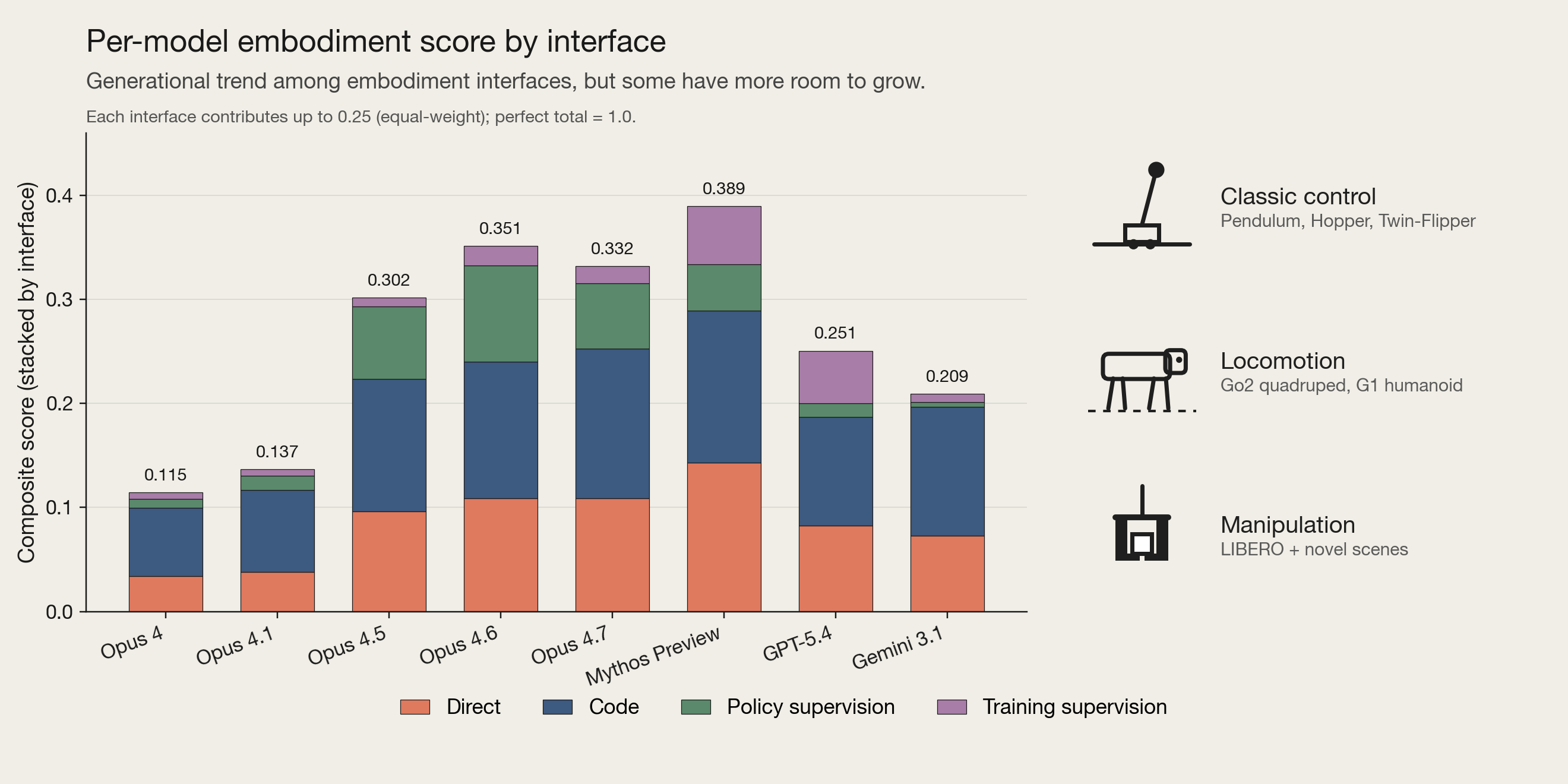
Anthropic's Embody composite score, stacked by control interface. Mythos Preview leads at 0.389, but the score averages bodies and tasks and excludes high-level locomotion. Source: Anthropic's robotics evaluation.
The chart is less a league table than a warning. The largest gains come when the model writes code, supervises a policy, or trains a controller. The direct-control slice stays small. Give a language model a good robot policy and it looks capable. Ask it to be the policy and the floor arrives quickly.
Raw torque is where the magic stops
Anthropic tested four ways for a model to act:
- Send low-level torques or forces.
- Write a Python controller that converts observations into actions.
- Give high-level commands to a pretrained robot policy.
- Train a policy with reinforcement learning, then deploy it.
Those are four different jobs hiding inside one robotics headline.
The simulated humanoid was a 29-DoF Unitree G1. No tested model stood it up from a collapsed pose even once. The 12-DoF Go2 was kinder: Opus 4.6, Opus 4.7, and Claude Mythos Preview could balance it for nearly two seconds when they wrote a Python controller.
Direct motor control was much worse. Anthropic paused the simulator between model calls, otherwise API latency would dominate the result. The study estimates real-time locomotion would need about 83 Hz, while non-reasoning inference ran at roughly 0.2 to 0.4 Hz. That is a fair way to isolate control ideas. It is also a generous upper bound on deployment.
I would not call this a general humanoid controller. A model that cannot recover a fallen G1 in simulation has no business being described as one.
A pretrained policy changes the story
The arm tests are more useful because they show both progress and its limit. On a 7-DoF Franka Panda arm running 40 LIBERO tasks, direct-control success ranged from 0% to 5.5%. Newer models reached objects, made contact, and grasped more often. They still rarely completed the whole task.
Then Anthropic gave Claude a better division of labour. MolmoAct, a pretrained vision-language-action policy, proposed the arm's low-level actions. Claude could accept, edit, or replace them.
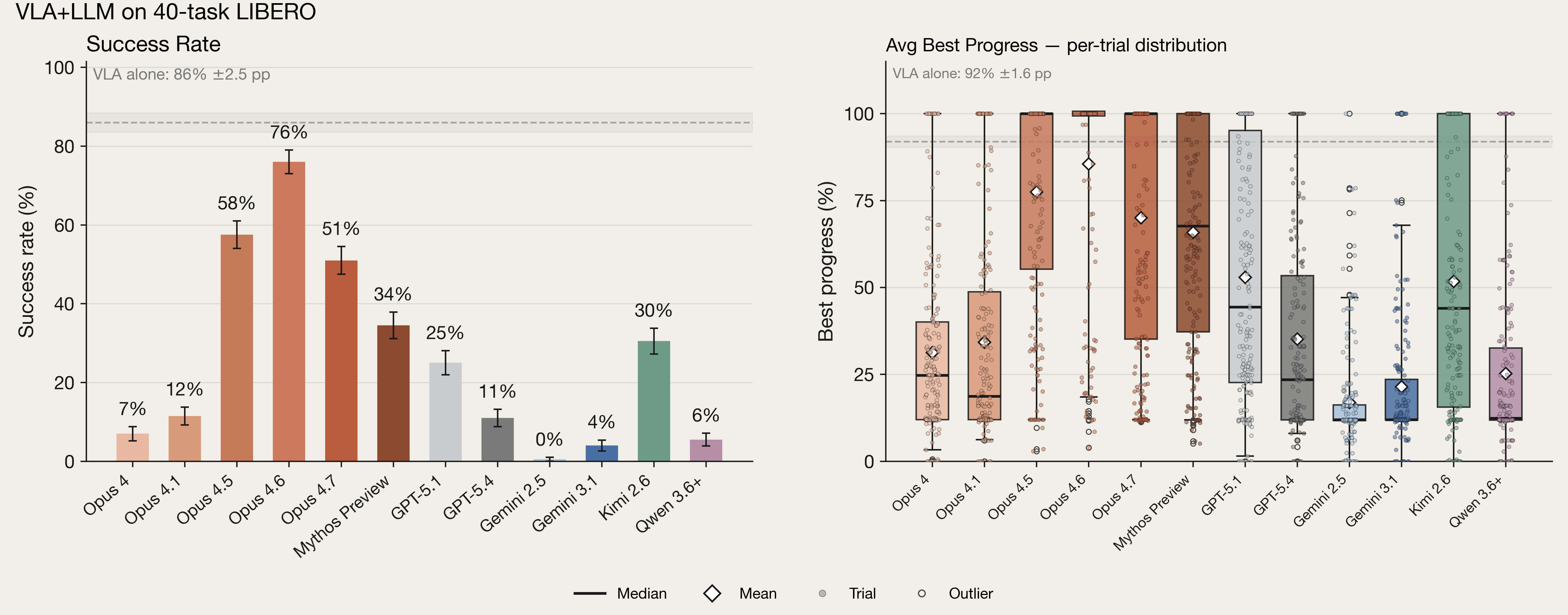
VLA-plus-LLM success on the 40-task LIBERO benchmark. The supervisor helps compared with direct control, but the standalone VLA remains ahead. Source: Anthropic's robotics evaluation.
Success rose sharply for every model on familiar LIBERO tasks. Opus 4.6 reached 76% in the published chart. MolmoAct alone reached 86%, so every language-model supervisor still made the system worse on the familiar set.
What I like about this result is the awkwardness. Anthropic does not get to call the language model a clean upgrade when the standalone policy still wins.
Claude Mythos Preview was the clearest warning. It overrode MolmoAct more often than was warranted and underperformed Opus 4.5 and 4.6. More intelligence did not produce better judgement. Sometimes the smartest action was to leave a working command alone.
The experiment becomes more interesting on three novel scenes where MolmoAct alone failed. Opus 4.5 and Opus 4.6 beat the standalone policy there. Claude can help when the controller meets a task outside its training distribution, but its best contribution is selective intervention. The robot needs a supervisor with restraint.
Keep the failures in frame
The trash-can incident was not the only physical warning. Anthropic says every model failed an office hallway loop with the Go2. Another model, Grok 4.1 Fast, saw the target table in a glass-door reflection and started moving towards the door. The robot was stopped before damage occurred.
This is the part I would put in a safety review, not hide in an appendix.
These are spatial failures, not failures of eloquence. The model can offer a plausible explanation of what it sees while being wrong about the geometry in front of the robot. A compass helped more consistently than depth overlays, a third-person camera, or a crosshair. Extra reasoning often did little or made performance worse. More written thought is not a substitute for knowing where the body is.
The study has limits that make the results easier to trust, if less exciting to repeat. Real-world runs were serial and low-count. Balancing attempts were reset between trials. When the quadruped started on its back, Opus 4.6 could not stand it up once. On a harder one-shot navigation course, twenty practice runs still produced no successful trials for the strongest models tested.
Claude learns from recent failures. It has not shown reliable long-range spatial planning.
The data lesson is about failures
I care about the study's data implication more than the model leaderboard. Anthropic suggests that models may eventually help generate robotic training data. Fine, but the useful signal will not be a folder of successful clips.
The performance gains often came from retries, changed strategies, and corrections after an action failed. A useful dataset should preserve the camera view, robot state, command, timing, task instruction, controller or policy version, outcome, and the failed attempts around the successful one. That is the difference between a demonstration and an explanation of behaviour. Polished success footage is the least interesting part.
Our guide to data modalities for robot training covers why video, state, actions, contact signals, language, and outcomes need to stay aligned. The humanoid robot data evaluation checklist is the next step for buyers: check embodiment, synchronization, provenance, and rights before paying for scale. Anthropic's experiment is a useful reminder that humanoid robot training data needs context around each action.
There is a reproducibility caveat. Anthropic says the evaluation code will be released at github.com/safety-research/embody. I could not access a public repository when I checked on 15 July 2026, so the appendix is doing the work for now. I would treat this as a serious research report awaiting a more inspectable release, not as a finished standard.
My verdict is favourable, with the hype removed. Anthropic has shown a model becoming physically consequential before it becomes physically reliable. Claude does not need to drive every motor to matter. It needs a camera, a competent controller, and permission to issue the next command.
The interesting frontier is not whether Claude can make a robot move. It is whether the system knows when to stop. Right now, the controller does the hard work, the model still loses the room, and the trash can still wins.