How Many Robot Demonstrations Do You Need to Train a Policy?
There is no universal episode count for robot policy training. Learn how task, object, environment, embodiment, and failure coverage change the answer.
12 min readRead article →
Browse humanoid robot and embodied AI training datasets. Explore source-backed articles and glossary definitions covering robot learning, hardware, control, and simulation.
Get new datasets, articles, and glossary entries in your inbox.
There is no universal episode count for robot policy training. Learn how task, object, environment, embodiment, and failure coverage change the answer.
A practical way to distinguish image capture, message arrival and robot execution time, with lessons from UMI and checks for demonstration datasets.
Compare ten wearable robot-learning capture systems by recorded video, motion and gaze data, export formats, access, pricing, and the tasks they can support.

Check collision geometry, friction mixing, contact settings and controller timing before trusting simulation-generated grasping and assembly data.

Eidon Tracker POV contains 13,451 egocentric recordings totalling 1,273.8 hours from 27 contributors performing household tasks, predominantly folding laundry. Head-mounted MP4 video spans 1080p to 4K, mostly at 30 fps. The companion tracker-pov-imu repository provides 24 Hz orientation quaternions for a seven-point harness on the hands, forearms, upper arms and chest, joined to video metadata by recording_id. Raw accelerometer, gyroscope and magnetometer readings are available for 2,841 recordings; 129 recordings have fewer than seven sensor slots. Video and IMU capture are not hardware-synchronised. Metadata includes activity labels and quality-control flags, including invalid recordings. Footage is unredacted; contributor-level splits and quality filtering are recommended. The separate 306-hour video-only bucket is not included in these totals.

The downloadable T-Rex release contains 5,464 teleoperated episodes—5,473,459 frames, or about 50 hours at 30 Hz—collected on a fixed-base bimanual Dexmate Vega-1 with two Sharpa Wave dexterous hands; the paper reports a 100-hour full corpus. The release spans 207 household objects and 22 motor primitives, including 5,370 language-annotated trajectories. Each episode aligns three RGB views, bimanual joint states and target actions, ten raw fingertip-tactile video streams, ten deformation-map streams, and per-fingertip 6-axis wrench signals in LeRobotDataset v3.0.
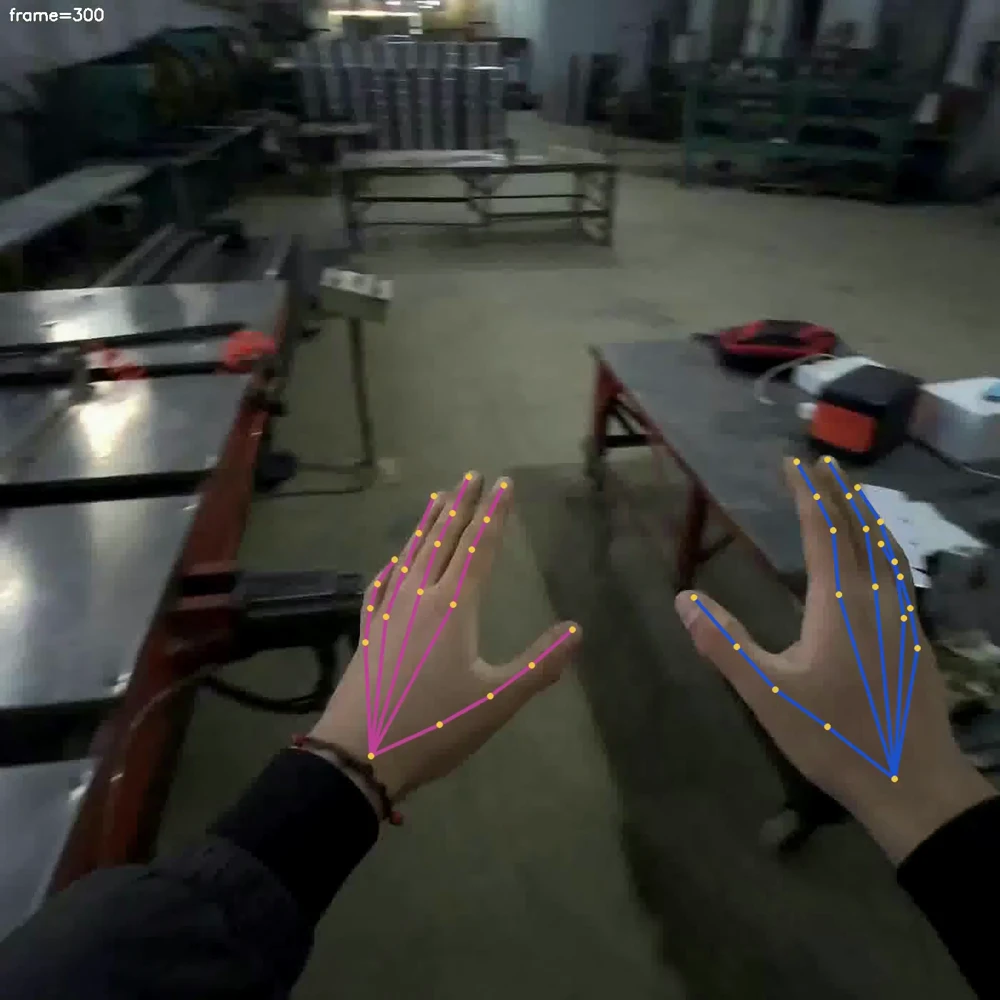
EgoSuite-Open100K is a staged 100,000-hour release of egocentric human demonstrations spanning more than 15,000 tasks and 15,000 distinct scenes across 18 task categories and seven environment categories. EgoStandard allocates 90,000 planned hours to head-view video with synchronized left and right 3D hand poses and optional full-body pose; EgoPro allocates 10,000 planned hours and adds wrist-view video. Data is distributed in LeRobot v3 and MCAP, with event-level semantic annotations on selected subsets; EgoDemo provides a 50-hour sample drawn from the four annotated sub-SKUs.
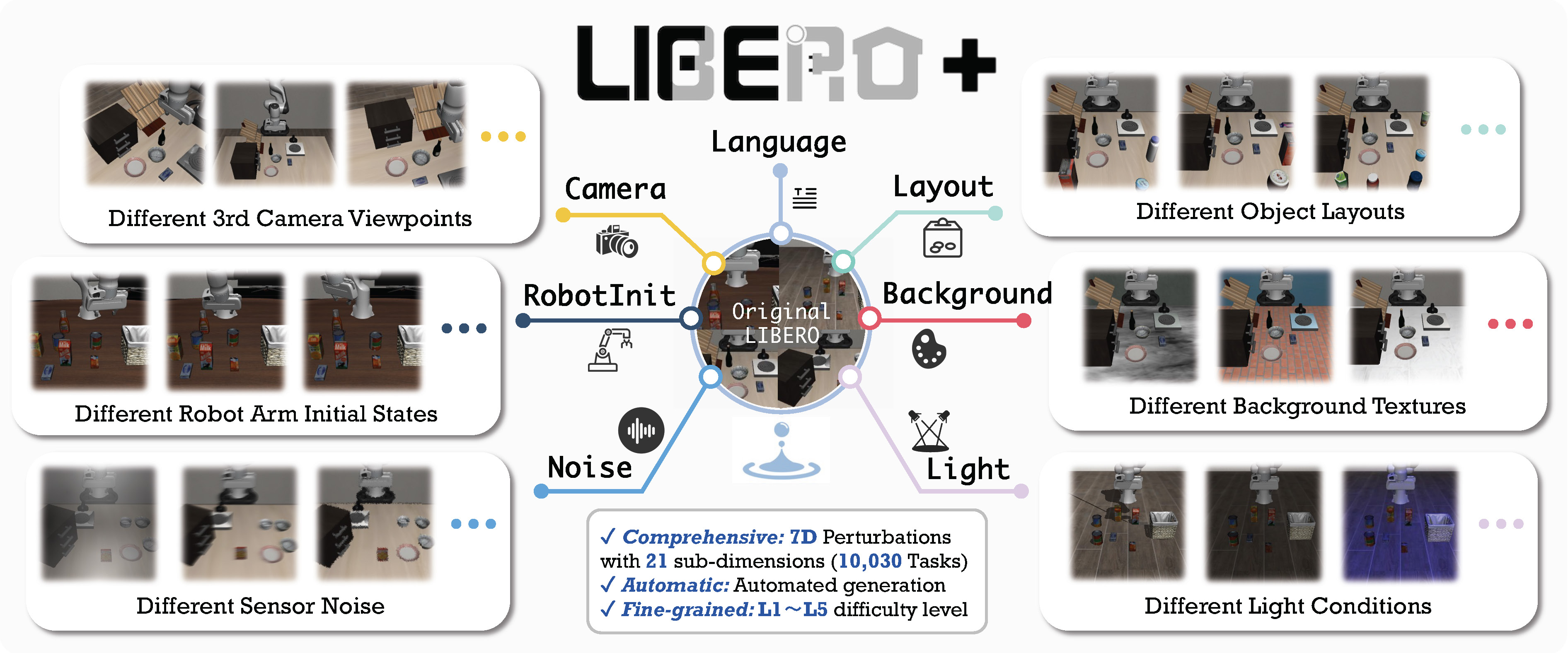
LIBERO-Plus expands LIBERO into a robustness benchmark with 10,030 test-only simulated task instances spanning seven perturbation factors and 21 subdimensions: object layout, camera viewpoint, robot initial state, language, lighting, background texture, and sensor noise. Tasks are generated automatically and stratified into five difficulty levels. The associated mixed training release contains more than 20,000 successful trajectories; its official LeRobot package exposes 14,347 episodes, 2,238,036 frames at 20 Hz, and 40 task labels with front and wrist RGB, robot state, and actions.