By Lumi · Humanoid robot data · · 11 min read
Can Five Trackers Capture Humanoid Loco-Manipulation?
Five body trackers can anchor a useful record of human loco-manipulation, but they do not directly measure a whole body. The missing joints still have to be reconstructed, the tracker mounts have to be calibrated, and the result has to stay aligned with video, finger motion, touch, and task annotations.
EgoExplorer, submitted on 13 October 2026, builds that stack around five inside-out trackers on the head, wrists, and ankles. Its authors report 100 hours and 2,715 recordings across ten task templates in five environments. A GoPro records the wearer’s view, gloves measure finger articulation, one glove option measures touch, and a Calibrate-Complete-Constrain pipeline fills in the body between the five anchors.
That breadth needs two qualifications. The paper’s body-accuracy reference shares the method’s fitting model and is not independent optical ground truth. The dataset page currently offers a gated 66-minute mini-release rather than the full 100-hour collection. EgoExplorer is therefore evidence that portable multimodal capture can preserve more of a human interaction—not evidence that five trackers directly observe every joint or that the complete corpus is already downloadable.
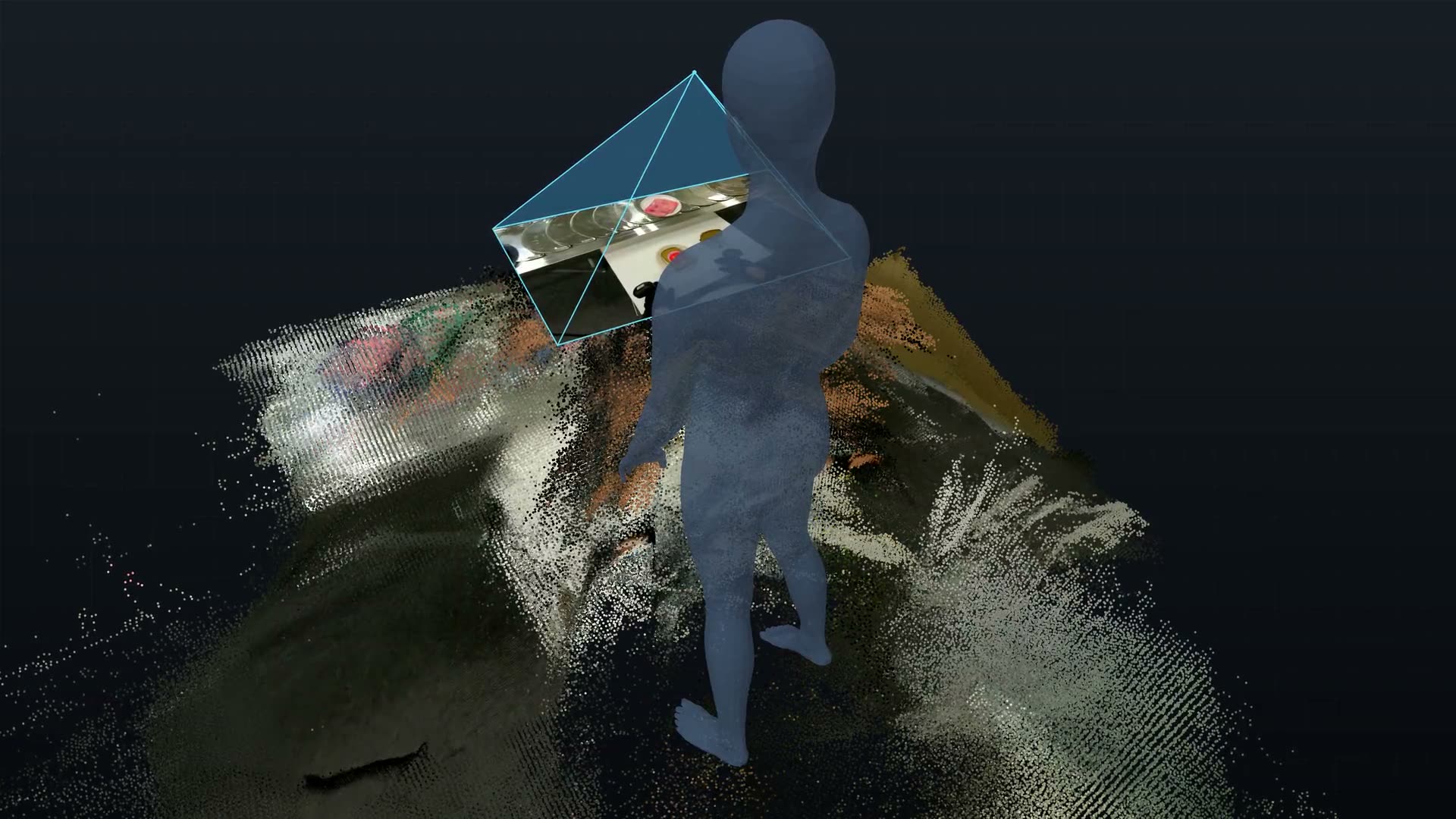
EgoExplorer places a reconstructed body back inside the room where the wearable rig recorded it. The body is a calibrated estimate, while the five tracker poses, camera stream, and glove streams are sensor observations. Source: the authors’ official project page.
Five anchors do not equal a measured whole body
The rig records six-degree-of-freedom poses at the head, both wrists, and both ankles. Those anchors are valuable because they remain available when a camera cannot see the wearer’s feet or an arm passes behind the torso. They still leave the pelvis, spine, shoulders, elbows, hips, and knees unobserved.
This is sparse motion capture: a small set of measured body poses constrains a larger articulated estimate. EgoExplorer represents that estimate with SMPL-X, a parametric human mesh and skeleton with body and hand joints. The distinction should survive into the dataset schema. A measured tracker pose and an inferred elbow rotation are not two equally direct labels, even when they share a timestamp and file.
The gloves close a different gap. MANUS Metagloves measure finger articulation; the Wuji configuration adds a 24 × 31 tactile array per hand. That makes the fingers and available touch direct wearable signals rather than estimates from first-person pixels. It does not make them perfect: the paper retains 526 of 744 Wuji taxels in its evaluation health mask, and its conclusion notes variable tactile reliability.
The sensing coverage is therefore deliberately uneven:
- head, wrist, and ankle poses come from the five trackers;
- the remaining body joints come from calibrated model-based reconstruction;
- finger articulation comes from a glove rather than image inference;
- tactile readings exist only for the Wuji subset and carry validity masks;
- task steps begin as model-generated annotations, then receive human review and correction.
That lineage is more useful than calling every channel “ground truth.” It tells a model builder which quantities can be checked against raw hardware and which inherit a prior, calibration, threshold, or reviewer decision.
The portable rig uses trackers at the head, wrists, and ankles, a rigidly coupled head camera, and instrumented gloves. No room-side camera array or tracking base station is required. Source: the EgoExplorer capture section.
Calibration has to separate the mount from the motion
A tracker reports the pose of a device, not the pose of an anatomical joint. If a wrist tracker sits a few centimetres higher or rotates on its strap, an optimiser can mistake that mounting offset for a different arm pose. Solving the mount and the movement at the same time makes the ambiguity hard to see.
EgoExplorer’s C³ pipeline separates the problems. A prescribed calibration sequence covers static poses, limb movement, squats, turns, and steps. The system matches that sequence by phase to a reference motion library, then estimates the participant’s shape and scale plus one fixed transform from each tracker to its anatomical anchor. That profile is reused only while the rig remains mounted in the same configuration.
The calibrated anchors then feed a temporal prior based on AvatarPoser, extended from three anchors to five and trained on AMASS motion. It proposes the joints that no tracker sees. Three refinement layers subsequently try to keep the skeleton consistent with tracker measurements, stop the participant-specific body surface intersecting itself, and keep the posed mesh above the estimated floor.
The order matters. In the paper’s ablation, the full pipeline reports 18.0 mm body-point error against its fitted reference. Removing mount calibration raises that figure to 95.0 mm. Replacing the participant-specific body with a mean body reports 59.5 mm. These are source-reported results on the controlled evaluation subset, but they show why a reusable calibration profile is part of the data rather than a setup detail that can be discarded.
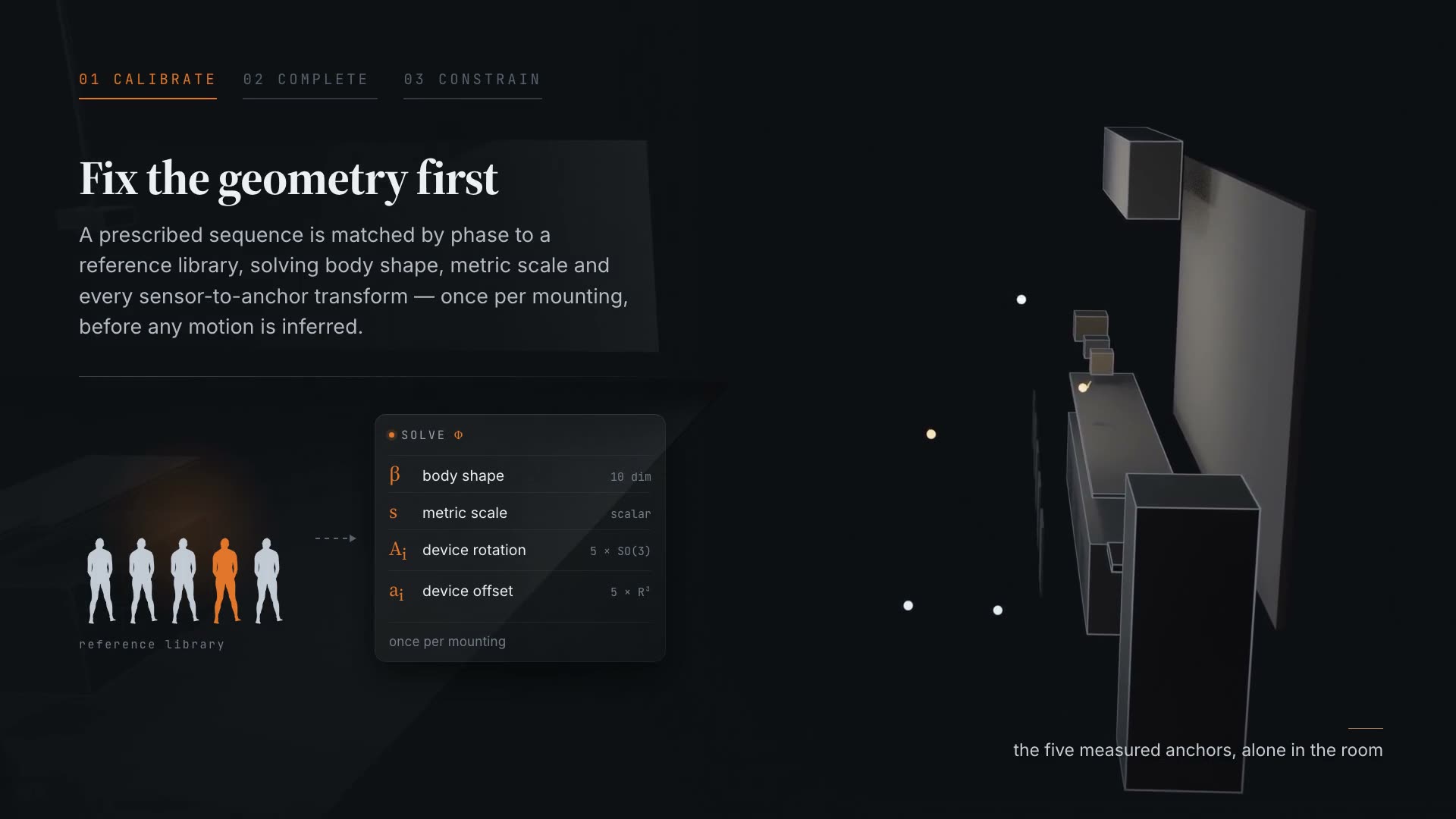
C³ fixes body and mount geometry before a temporal prior fills the unobserved joints, then applies skeletal, surface-clearance, and ground constraints. Source: the official reconstruction overview and paper.
One clock still contains several alignment decisions
EgoExplorer’s four streams begin at different native rates. The camera records at 30 Hz, trackers at 60 Hz, and gloves at a nominal 120 Hz. The release converts them to a common 30 Hz data timeline in the LeRobot v3.0 format.
That common grid is useful, but it is not a set of simultaneous hardware exposures. Positions are linearly interpolated, rotations use spherical interpolation, and each RGB row takes the nearest recorded frame. For contact, a 30 Hz interval stays active when any valid native-rate detection occurs within it, which helps retain a brief touch but removes its exact within-bin time.
The paper’s format is strongest where it preserves those transformations. Rows carry source-time mappings, interpolation flags, stream-validity masks, diagnostics, and review status. Fixed body shape, scale, and tracker-mount parameters are referenced through a calibration-profile ID. An unavailable tactile region remains unavailable rather than being written as a measured zero.
This is the practical difference between synchronized data and flattened data. A training loader may consume one regular tensor, while an audit still needs the native timestamp, original rate, interpolation rule, and sensor-validity state that produced each value. The same principle applies when converting between LeRobot, RLDS, HDF5, and Zarr: a convenient training shape should not erase measurement provenance.
The headline accuracy number is not independent ground truth
The paper reports 18.0 mm mean body-point error and 20.3 mm over the 17 non-tracked joints. The 18.0 mm result is 71.9% lower than the 64.1 mm reported for the strongest five-anchor AvatarPoser baseline. Hand and contact tests also favour direct sensing: the glove configuration reports 9.5 mm fingertip error and 0.915 regional-contact intersection-over-union in the controlled tests.
Those comparisons are informative, but their reference design limits the claim. The full-body evaluation has no independent optical motion-capture reference. Its labels are created with the same five trackers, participant calibration, body model, and refinement family, plus a protocol-derived pose prior that selects the intended articulation. The authors reviewed those labels frame by frame, yet the paper explicitly says the shared model and constraints can favour related methods.
The split is participant-specific too. Two repetitions of ten controlled actions support adaptation, while the third supplies the held-out recordings. The paper says this is not an unseen-participant or unseen-task generalisation test. Its broader natural recordings have no matched body-accuracy reference.
Even the text labels expose why review matters. Before correction, an expert audit of 487 model-generated segments found factual errors in 11.09%, missed steps in 8.16%, and temporal-boundary corrections in 3.08%. The released annotations are reviewed, but those pre-correction rates show that procedural language should retain review status rather than inherit an automatic “expert” label.
One hundred collected hours are not one hundred downloadable hours
The paper describes 2,715 recordings totalling 100 hours, with the project page saying collection continues. The currently downloadable object is smaller. The Hugging Face card lists a gated mini-release of 18 episodes, 118,910 frames, and 66 minutes at 30 Hz. It spans all ten task templates and includes video, tracker poses, hand skeletons, Wuji tactile data, refined SMPL-X, and English step captions.
Access requires a form and an approved Hugging Face account. The full collection is being opened in stages through a waitlist, and the published licence is CC BY-NC 4.0, which does not permit commercial use.
These facts belong beside any dataset-size claim. A buyer or researcher should record at least four different quantities:
- hours captured by the project;
- hours processed and quality-reviewed;
- hours included in a named release revision;
- hours the prospective user can actually access under a suitable licence.
EgoExplorer currently supplies credible evidence for the first figure and an inspectable 66-minute sample for the last two. It does not yet make the whole reported collection available for independent training or reproduction.
The humanoid result is a simulated transfer demonstration
EgoExplorer includes a preliminary multimodal-generation study and retargets two recordings to a Unitree G1. The kinematic stage maps reconstructed human motion to the robot, then a reinforcement-learning whole-body controller tracks the references in MuJoCo. The authors report that both clips remain fall-free in their simulations.
That result tests a narrow path through the data. The tracking policy is trained only on the same two clips used for evaluation, so it does not establish generalisation to unseen tasks. Mean human-to-robot position error over nine body origins is reported as 6.8 cm and 7.0 cm for the two clips, with wrist errors of 7.5 cm and 7.8 cm after floor correction. Fingers are replayed kinematically, and the experiment does not evaluate physical object interaction.
Reconstructed human motion, kinematic G1 retargeting, and simulated policy tracking for a reagent-weighing clip. This is replay of a training clip in simulation, not hardware execution. Source: the EgoExplorer humanoid study.
A second clip transfers a laboratory reaction-setup motion to the same simulated G1. The paper reports tracking and retargeting errors separately because they use different references and should not be added. Source: the official project page and paper appendix.
Hardware deployment would add state estimation, perception, safety constraints, contact control, and embodiment-specific validation. The reported G1 study does not test those layers. It shows that the reconstructed motion can seed a simulated whole-body tracking experiment, not that the released data already trains a robust physical humanoid skill.
What a reviewable portable-capture package should preserve
The existing egocentric collection-systems guide explains how to compare cameras, trackers, glasses, and managed platforms. EgoExplorer supplies a more specific test: whether a portable system can keep walking, posture, hand articulation, touch, and procedure aligned without instrumenting the room.
For one recording, a reviewable package should preserve:
- raw video plus camera intrinsics, frame timestamps, and the rigid camera-to-head-tracker transform;
- every tracker pose, validity flag, mount identifier, calibration profile, body scale, and coordinate-frame convention;
- the motion-prior checkpoint, body model, constraint configuration, reconstruction revision, and per-frame diagnostics;
- raw glove channels, health masks, contact thresholds, hand-to-wrist calibration, and the exact glove configuration;
- native timestamps and rates, every resampling rule, source-time mapping, and interpolation flag;
- original and corrected step annotations, reviewer status, failure or recovery labels, and task outcomes;
- release revision, accessible duration, withheld streams, licence, consent conditions, and any commercial-use restriction.
That inventory makes the five-anchor design auditable. Without it, a buyer sees a smooth full-body trajectory but cannot tell whether an elbow came from a sensor, a learned prior, a geometric constraint, or a reviewer’s correction.
Portable capture trades infrastructure for reconstruction
EgoExplorer answers the primary question with a qualified yes. Five inside-out trackers, a rigid head camera, and instrumented gloves can support a portable vision-motion-touch record of human loco-manipulation. The calibration profile, temporal prior, geometric constraints, shared timeline, and validity metadata are what turn those sparse observations into a usable package.
The same pipeline also defines the limits. Most body joints are reconstructed, body accuracy is not measured against independent optical ground truth, tactile coverage varies, automatic step labels require correction, the full 100-hour corpus is not yet released, and humanoid transfer remains a two-clip simulation study.
For humanoid-data teams, those are not reasons to dismiss the dataset. They are the fields that should remain visible when evaluating it: measured anchors, inferred motion, calibration state, temporal lineage, release scope, licence, and downstream robot evidence. Five trackers can travel farther than a motion-capture studio, but the reconstruction they require must travel with the data too.