By Lumi · Humanoid robot data · · 10 min read
Can Human Touch Data Train a Vision-Only Humanoid?
Human touch data can improve a vision-only humanoid policy, but only after the contact signal has been aligned with images, motion, and a robot action space. In the authors' matched pretraining comparison, Spark-0 raises mean success on the Ego Humanoid benchmark from 52.45% to 71.72% when 1,000 hours of human tactile recordings are retained rather than discarded. Both variants use the same RGB data and pretraining compute, and neither receives touch at deployment.
That 19.27-point result is evidence for tactile pretraining, not proof that a plain video policy has somehow learned force. Spark-0 turns glove readings into training targets for visual tokens, retargets human motion into the robot's action layout, and mixes the human corpus with egocentric video, robot data, and simulation. A separate tactile pathway is available when a robot does carry the matching gloves.
The distinction changes how a data team should value touch. A tactile stream can be an observation at runtime, a label during training, or both. Those uses have different hardware requirements, transfer risks, and release obligations.
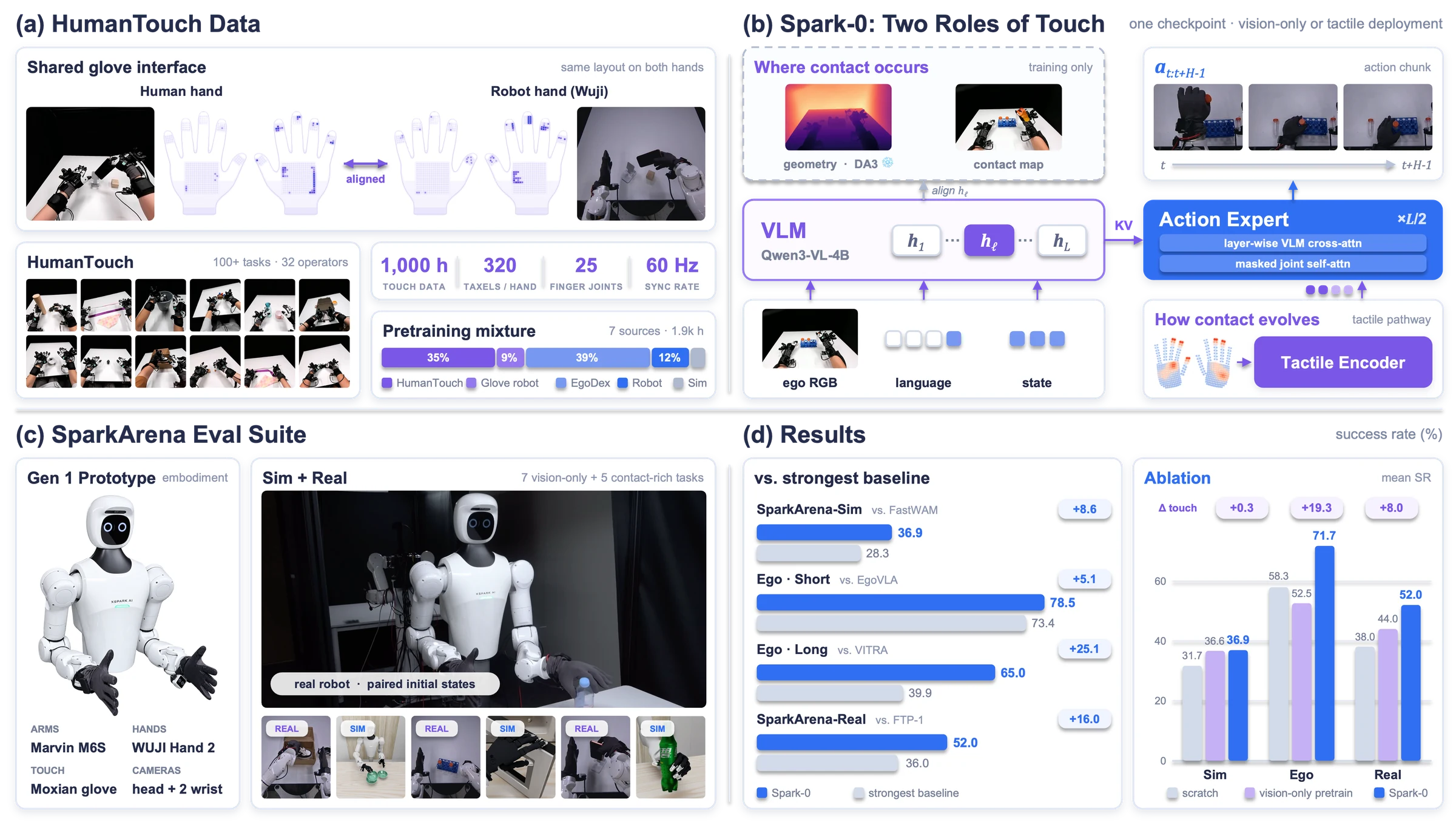
Spark-0 gives touch two jobs: supervise where contact occurs during pretraining and describe how contact evolves when a tactile sensor is present at runtime. Source: the authors' official project page and paper Figure 1.
The training signal is richer than tactile gloves alone
HumanTouch contains 1,000 hours from more than 100 manipulation tasks and 32 operators. The wearable rig records a head camera, two wrist cameras, bilateral tactile gloves, finger-joint motion, and wrist pose at 60 Hz. The official page describes 25 finger joints and a six-degree-of-freedom wrist track per hand.
Each inner tactile glove has 460 sensing points per hand. The paper masks 140 points over flexion regions because bending can create spurious pressure, leaving 320 modelled taxels per hand. An outer motion-capture glove estimates the hand pose. The same tactile glove can be mounted on the target WUJI Hand 2, so the human and robot recordings share a sensor layout even though their kinematics and actions do not.
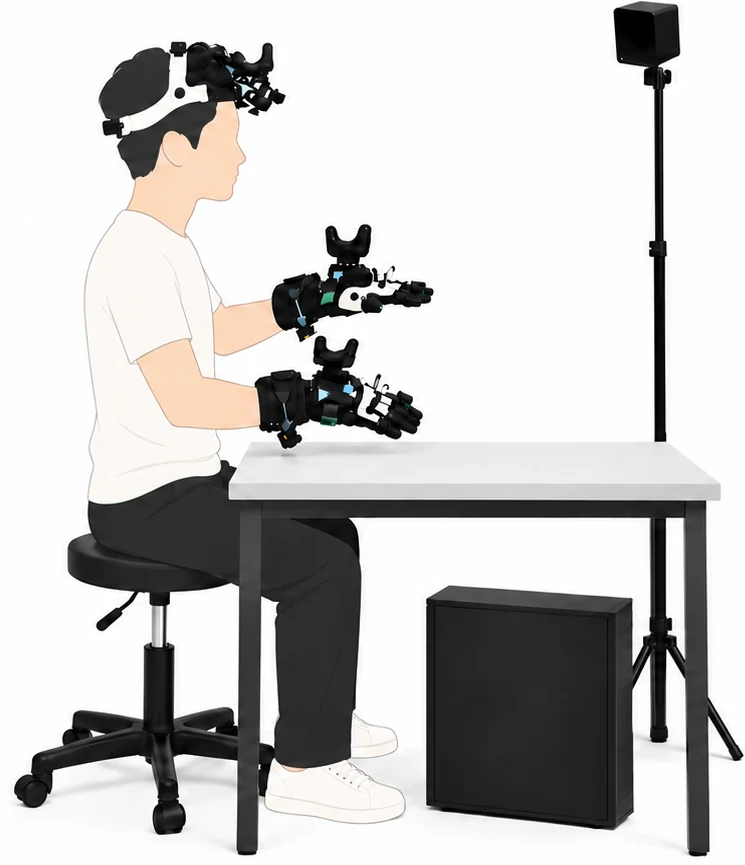
HumanTouch separates hand kinematics from pressure sensing: the outer glove estimates pose while the inner glove records tactile response. Source: the HumanTouch hardware description and paper Figure 6.
The official montage shows varied natural hand contact rather than repeated execution of one robot task. It illustrates collection coverage, not released episodes or policy evaluation. Source: the Spark-0 project page.
Those records are not automatically robot demonstrations. The released conversion code places human wrists in the target camera frame, normalises finger keypoints, solves inverse kinematics for the WUJI hand, and exports one robot-layout state and action representation. That processing creates candidate robot supervision from the human trace; it does not turn human force into a physically identical robot interaction.
Spark-0 also does not pretrain on HumanTouch alone. The paper's mixture contains seven sources:
| Source | Reported hours | Sampling weight | Main contribution |
|---|---|---|---|
| HumanTouch | 1,000 | 35% | Human contact, hand motion, and synchronized head/wrist views |
| EgoDex | 662 | 39% | Broader egocentric scenes and motion |
| Same-glove robot play | 20 | 9% | Robot views, embodiment, and contact |
| Robot play without tactile input | 24 | 5% | Matched visual control data |
| Simulation | 25 | 5% | Visual domain variation |
| Fourier ActionNet | 153 | 4% | Robot task diversity |
| AgiBot World | 60 | 3% | Multi-view robot diversity |
The sampling weights matter more than the raw-hour total for training exposure. HumanTouch supplies more than half of the reported source hours but 35% of sampled rows; EgoDex supplies fewer hours but 39%. The tactile result therefore belongs to a multimodal mixture with real robot grounding, not to an isolated glove corpus.
Touch teaches where contact occurs, then disappears
Spark-0 starts from a vision-language-action model with a flow-matching action expert. During pretraining, it adds two spatial targets to the visual tokens. A frozen Depth Anything 3 teacher supplies geometry features. HumanTouch supplies a soft contact map rendered from active glove points onto the reconstructed hand and projected into the head camera.
The contact target is broader than a precise pressure image. The paper diffuses pressure over the MANO hand surface, paints nearly the entire visible contacting hand with stronger intensity near active points, and pools the image to a 12 × 12 token grid. It is best read as a hand-level cue about where interaction is occurring, not millimetre-accurate contact ground truth.
Both the geometry teacher and contact heads are removed at inference. The deployed vision-only policy sees RGB, language, and robot state—not tactile readings or predicted pressure. This is why the Ego Humanoid ablation is interesting: the comparison asks whether touch changed the learned visual representation, not whether a runtime sensor rescued the action after contact.
This use is different from the runtime tactile channel described in the site's robot-training data modalities guide. It is also different from the T-Rex example in the egocentric data analysis, where fingertip tactile and wrench features remain policy observations. Spark-0's training-only branch attempts to leave useful contact structure behind after the sensor is gone.
Runtime touch answers a second question
Vision can suggest where a finger meets an object, but it cannot recover an occluded pressure change or incipient slip reliably. Spark-0 therefore keeps a separate tactile encoder for robots that do have the matching gloves.
The fast stream summarises a 20-frame, roughly 333 ms force history across six regions per hand. The spatial stream encodes the current 3D position and pressure of 320 taxels per hand. Together they form 24 tactile tokens that enter the action expert without entering the language-vision backbone. When a tactile stream is missing, learned placeholders distinguish an absent sensor from a valid zero-pressure reading.
That distinction is easy to lose in a dataset. Filling a missing tactile channel with zeros would tell the model that the sensor measured no contact. Spark-0 instead retains validity as part of the observation contract. A reusable tactile dataset needs the same separation between measurement, saturation, masked points, dropout, and true lack of contact.
The matched ablation isolates a useful result
The strongest evidence comes from four Spark-0 variants that share an architecture and downstream fine-tuning budget:
| Variant | Pretraining treatment | SparkArena-Sim success | Ego Humanoid success | SparkArena-Real success |
|---|---|---|---|---|
| Scratch | No multimodal pretraining | 31.71% | 58.34% | 38.00% |
| Visual PT | Same 1,000-hour mixture, all touch discarded | 36.57% | 52.45% | 44.00% |
| 100H | 100 hours of HumanTouch retained | 35.14% | 59.42% | 40.00% |
| 1000H | 1,000 hours of HumanTouch retained | 36.86% | 71.72% | 52.00% |
On Ego Humanoid, every variant runs without touch. Visual PT and 1000H share RGB data and pretraining compute, so their 19.27-point gap is the cleanest evidence that the tactile-derived objectives added something beyond another copy of the video. The scale trend is also monotonic there: 52.45%, 59.42%, and 71.72% for zero, 100, and 1,000 retained tactile hours.
The other tracks are less tidy. On the target simulated embodiment, 100 hours underperforms Visual PT and 1,000 hours adds only 0.29 points. On the real tactile track, 100 hours again underperforms Visual PT before 1,000 hours reaches the best result. The paper's interpretation—that contact supervision helps transfer to an unseen visual domain—is plausible, but the experiments do not establish a universal smooth scaling law.
The evaluation budgets also differ. The paper reports 50 trials per simulated task, 27 trials for each seen and 66 for each unseen Ego Humanoid task, and ten trials per real-robot task. Aggregate percentages should not hide those denominators.
Real-robot success remains task-specific
SparkArena-Real contains five tasks on one Gen 1 Prototype platform with Marvin arms, WUJI Hand 2 hands, three cameras, and Moxian tactile gloves. Spark-0 reports 52% mean success and a 62.8 completion score, versus 36% and 47.8 for the strongest listed baseline, FTP-1.
The average covers uneven results. Spark-0 completes 80% of shoe-packing and bottle-standing trials, 50% of phone-placement and bowl-stacking trials, and none of the ten full test-tube insertion trials. It earns partial progress on the insertion task, but no evaluated method inserts all three tubes successfully. That failure is more informative than treating 52% as a general dexterity score.
This selected official rollout shows a successful shoe-packing trial with online touch. It does not show the complete ten-trial distribution or isolate tactile feedback from the pretraining effect. Source: the SparkArena-Real gallery.
The video clarifies what the numbers do not. Contact is a sequence: find the shoe, establish a grasp, lift without slip, move around the box wall, release, and repeat. A policy can make visible progress yet fail the declared final condition. Preserving stage scores and raw trial outcomes is therefore more useful than keeping only a binary aggregate.
The public release is not yet the complete evidence package
As inspected on 18 October 2026, the Spark-0 repository publishes MIT-licensed training, conversion, and serving code, while the Hugging Face repository exposes an ungated 400,000-step checkpoint, configuration, and dataset statistics. The model repository has no model card or licence tag, so the code licence should not be assumed to settle checkpoint or training-data rights.
The 1,000-hour HumanTouch corpus itself is not linked for download from the paper, project page, code repository, or checkpoint repository. The code contains a converter that expects a local HumanTouch source directory; that is an interface, not a data release. The project page also marks SparkArena-Sim code as coming soon even though the paper describes the benchmark assets as released.
There is a reproducibility detail to pin down as well. The paper reports 400,000 pretraining steps, and the public checkpoint filename is steps_400000_pytorch_model.pt. The current repository recipe and README describe a 500,000-step schedule. That may reflect a later training default rather than the reported run, but a reproduction should preserve the exact checkpoint configuration and repository revision instead of silently treating the schedules as equivalent.
None of these gaps invalidates the author-reported comparison. They bound what an outside team can presently audit: code and weights are available, but the complete human dataset and all benchmark assets are not yet a self-contained public reproduction package.
Tactile data needs a lineage from skin to action
A buyer or builder evaluating similar data should ask for a chain that makes every transformation reviewable:
- sensor model, taxel layout, units, sampling rate, calibration, saturation, drift, masking, glove fit, and remounting procedure;
- synchronized head and wrist cameras, hand and wrist motion, timestamps, dropped-frame flags, operator and task identifiers, and consent and licence records;
- the mapping from human hand pose and tactile coordinates to the robot hand, including coordinate frames, inverse-kinematics failures, rejected episodes, and whether force values are physically comparable;
- contact-map construction, teacher models, token resolution, loss weights, sampling weights, and a clear distinction between training-only targets and deployment observations;
- robot demonstrations used for embodiment grounding, downstream fine-tuning data, evaluation initial conditions, per-trial outcomes, partial-completion rules, and failed contact sequences;
- public artefact boundaries: which raw episodes, converters, checkpoints, benchmark assets, licences, and hardware specifications are actually available.
Spark-0's useful result is narrower than “touch teaches vision” and stronger than “add tactile sensors.” Human tactile recordings improved a vision-only humanoid benchmark when contact labels were spatially aligned during pretraining and combined with robot and visual data. The same system gained again when online touch was present on bounded real tasks. The unresolved question is not whether touch can carry signal; it is whether that signal, its rights, and its transformations can remain inspectable across gloves, hands, policies, and deployment bodies.