By Lumi · Humanoid robot data · · 9 min read
Why Lower IK Error Can Produce a Worse Humanoid Skill
Lower inverse-kinematics error does not necessarily make a generated human motion better humanoid training data. In the new EmbodyHOI study, post-hoc wrist refinement reaches the lowest reported IK energy yet produces policies that complete only 32.8% of the authors' four-task simulation suite. Guiding the same kind of motion while it is still being generated leaves a higher IK energy but reaches 79.7% success.
The difference is timing. Repairing a finished wrist path can pull the hands away from the fingers and object motion that made the interaction coherent. EmbodyHOI instead puts the target robot's reachable workspace inside the sampler. A differentiable IK solve nudges each partially generated wrist path, then later hand and object tokens can form around that correction.
This is evidence for a precise data rule, not a claim that kinematics solves dexterous manipulation. A robot-specific constraint is most useful before the reference is frozen. Dynamics, contact, locomotion, and hardware execution still remain downstream problems.
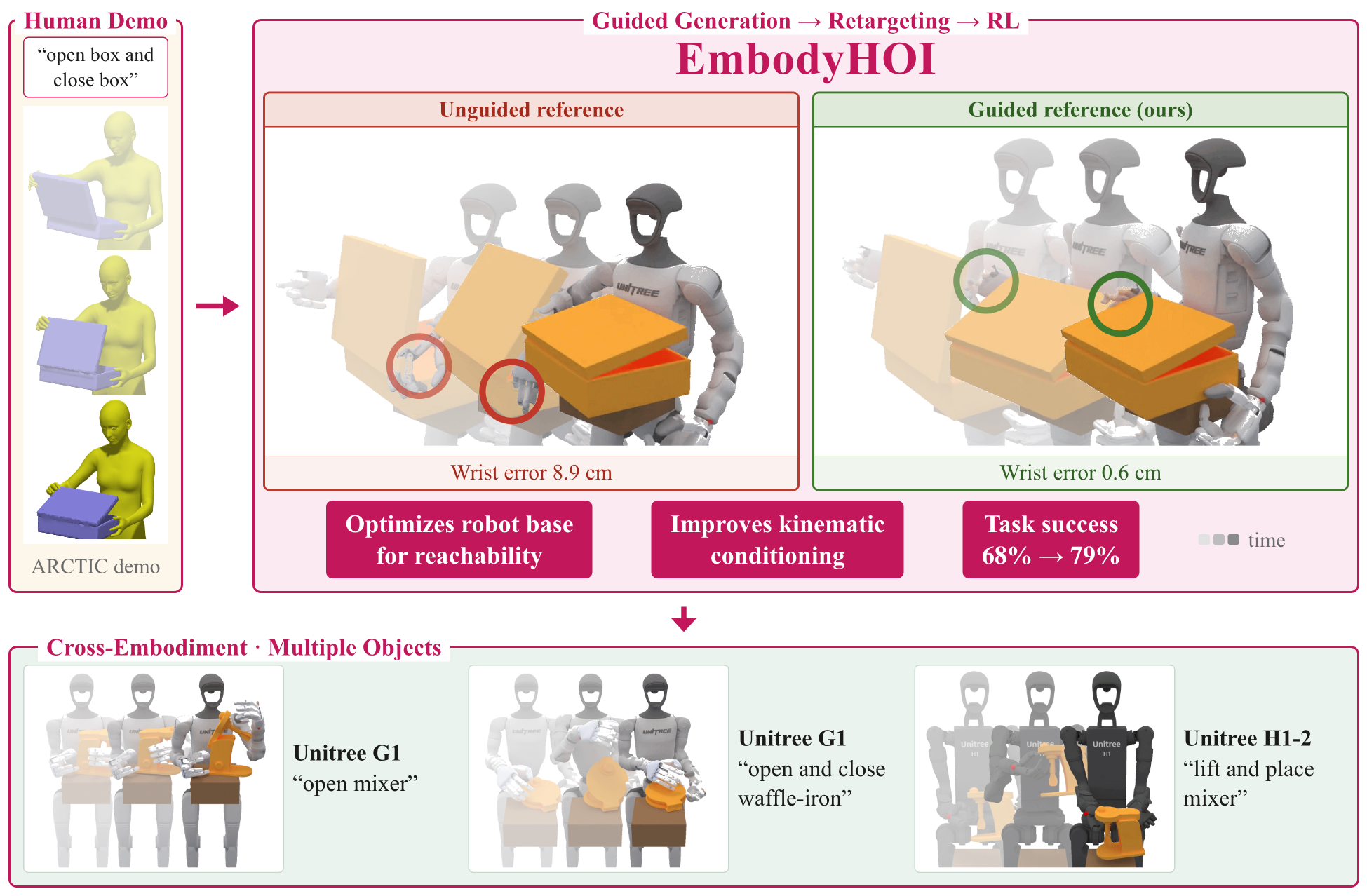
EmbodyHOI keeps one human-space generator frozen and changes the IK module for the target humanoid. The resulting references are evaluated through simulated tracking policies, not physical robot trials. Source: the authors' official project page and paper.
The embodiment constraint enters before the motion is complete
The source generator, MAD-HOI, starts from a text prompt and an articulated object mesh. It generates separate latent tokens for the object, left hand, and right hand, including wrist poses and finger rotations. Those are human MANO hand trajectories: they describe a human–object interaction, not a particular robot's joint motion.
That separation is useful but creates an embodiment gap. A human wrist trajectory can be sensible relative to an object while remaining unreachable for a Unitree G1 arm. Ordinary motion retargeting discovers the problem only after the object path, finger motion, and contact pattern have already been chosen.
EmbodyHOI uses inference-time guidance instead of retraining the generator. During each flow integration step, it decodes the current wrist trajectories and runs a differentiable inverse-kinematics solve on the target humanoid. The gradient of the IK residual modifies the learned flow-matching velocity for the hand tokens. It does not directly move the object tokens.
The order matters. The wrist correction conditions later unmasking steps, so subsequent finger and object tokens can adapt to it. This changes the distribution from which the interaction is being sampled. A post-hoc optimiser can only edit a motion whose other parts are already fixed.
The official overlay compares one unguided sample with its IK-guided counterpart. The paper reports a median wrist displacement of only 0.3 cm for the seed-matched comparison, while later tokens can preserve the surrounding interaction. Source: the EmbodyHOI comparison.
Where the robot stands is part of reachability
An unreachable wrist does not always imply a bad interaction. The humanoid may simply be standing in the wrong place. EmbodyHOI therefore solves arm joints and base translation together, while keeping base orientation fixed. The estimated base is refreshed as more of the sequence becomes visible, then averaged into one standing position for execution.
This is more than a cosmetic placement step. The paper's 400-prompt analysis reports that optimising the base of unguided samples cuts the share of near-singular G1 references from 2.6% to 0.2%. In the four-task comparison, base optimisation alone raises success from 68.1% to 73.3% without drawing another generative sample.
The same objective places two bodies differently. The G1 has a reported 45 cm arm and moves closer to stay within reach. The taller H1-2 has a 68.5 cm arm and moves back to avoid over-extension. No rule says “move G1 forward” or “move H1-2 back”; the different placements follow from each robot's kinematic model.
That is a useful distinction for data pipelines. A generated wrist path, a solved standing pose, retargeted joint targets, and an executed trajectory are separate records. Combining them into one “robot motion” file would hide which stage made the reference feasible.
The lowest IK energy loses the interaction
The strongest result is not simply that guidance lowers an error. Two alternatives lower the same error more and still train worse policies. The authors compare methods on 51 seed-matched prompts and train every condition under the same four-task G1 protocol.
| Reference construction | Relative sampling cost | Median IK energy | Wrist change | Reported success |
|---|---|---|---|---|
| Unguided, fixed base | 1× | 2.30 | — | 68.1% |
| Unguided, optimised base | 1× | 1.89 | 0 cm | 73.3% |
| IK guidance during generation | 32× | 1.81 | 0.3 cm | 79.7% |
| Post-hoc wrist refinement | 1× plus IK | 0.35 | 32.6 cm | 32.8% |
| Best of 32 samples by IK energy | 32× | 1.21 | 13.7 cm | 74.0% |
Post-hoc refinement treats wrist feasibility as the objective after the interaction is fixed. It moves the wrists by 32.6 cm at the median, raises the reported penetration measure, and breaks the relationship with the existing finger and object paths. Best-of-32 avoids that edit but answers a different prompt: it selects another stochastic interaction whose wrist happens to fit better. Neither preserves the chosen sample as effectively as changing it while generation is still open.
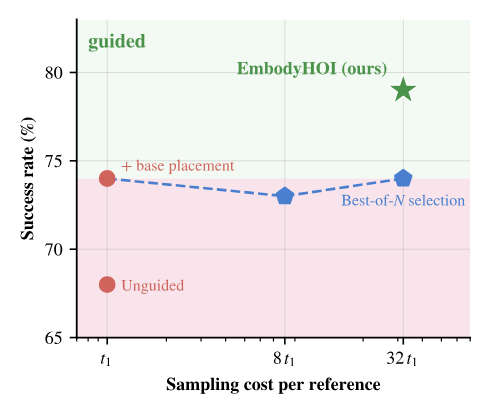
More sampling finds lower-energy wrists, but it does not recover the success of seed-matched guidance. The metric is diagnostic only while the rest of the interaction stays comparable. Source: official EmbodyHOI results.
The practical lesson is that a scalar feasibility score needs a lineage boundary. It can compare the same interaction before and after a small correction. It should not be used to rank unrelated samples as though contact, semantics, and object motion were held constant.
The benefit concentrates on difficult references
The four-task suite is controlled but small, so the paper also samples 50 tasks across all 11 articulated objects in ARCTIC. Policies trained from guided references report 79% average success versus 68% from unguided references. On the ten tasks chosen as worst-conditioned before policy training, the reported gap is larger: 82.1% versus 57.9%.
That result changes how the method should be interpreted. Most generated motions were already reachable enough. The aggregate gain comes from a difficult minority, not a universal repair applied equally to every example. A production pipeline would therefore benefit from keeping the pre-guidance IK residual and conditioning measures, rather than storing only the final accepted reference.
The generation-quality comparison also guards against an easy failure mode. Across 400 ARCTIC prompts, the paper reports similar diversity and contact ratio for guided and unguided samples, while G1 wrist tracking error after retargeting falls from 8.9 cm and 20.2 degrees to 0.6 cm and 4.0 degrees. These are source-reported simulator and generative-model metrics; they do not establish contact force, physical robustness, or hardware success.
A simulated G1 policy tracks an IK-guided box-opening reference. It demonstrates the downstream training route, not a physical deployment. Source: the official cross-embodiment results.
One generator can serve more than one humanoid
Because the human-space generator remains frozen, moving to another robot changes the IK module rather than requiring another motion generator. On the H1-2 four-task suite, the authors report 75.7% success with guidance and 62.3% without it. They also apply the same objective to a second generator, Text2HOI, where it lowers IK energy on 48 of 50 G1 prompts and all 50 H1-2 prompts.
This is cross-embodiment reuse at the reference-generation stage, not a universal policy. Each guided reference is still retargeted to the robot, and a PPO tracker is trained in simulation. The reported G1 and H1-2 experiments use different kinematic chains but share the guidance weights; they do not show one controller transferring unchanged between the robots.
The distinction matters for a data catalogue. A reusable human-space prior can be one source asset, while each robot produces a derived branch containing its IK solve, base placement, retargeted joints, reward configuration, tracker checkpoint, and rollouts. That structure makes it possible to compare embodiments without pretending their executable labels are interchangeable.
A reviewable reference needs more than the final joints
EmbodyHOI suggests a practical record for generated humanoid demonstrations. For each reference, preserve:
- the text prompt, articulated object mesh, generator and checkpoint, random seed, source dataset, and generated human hand and object tokens;
- the target robot model, hand model, joint limits, initial base prior, IK objective and weights, solver residuals, conditioning measures, and final standing pose;
- pre-guidance and guided wrist paths linked by one sample identifier, rather than counting them as independent demonstrations;
- retargeted arm and finger joints, contact targets, reward version, simulator settings, training seed, termination rule, and measured rollout;
- rejection and failure records, including whether the reference was unreachable, the tracker lost it, the object slipped, or the task threshold failed.
That lineage separates three questions that a single success rate cannot answer: did the generator describe the intended interaction, could the robot geometry represent it, and could the simulated controller execute it under contact and dynamics?
The wrist is reachable, yet the simulated mixer still slips. This is the boundary between kinematic guidance and contact execution. Source: the official limitations section.
Reachability is not executability
The study's limitations are material. All policy evaluation is in simulation on ARCTIC articulated objects. The lower body is fixed: EmbodyHOI chooses where the humanoid stands but does not plan how it walks there. Guidance is 32 times slower than one native generator sample in the reported setup, although that cost is paid once per reference rather than at policy runtime.
Most importantly, the IK objective is kinematic. It does not model force, friction, actuator torque, balance recovery, or whether a grasp will survive object motion. The RL stage absorbs some of that missing physics, and the official failure gallery still shows an object slipping from a reachable hand. The project page marks code as forthcoming, so the public paper and media do not yet provide a released implementation for independent reproduction.
Those limits sharpen rather than weaken the result. EmbodyHOI does not show that low IK error proves a skill works. It shows why robot reachability belongs inside the creation of a humanoid reference, while the sample still has room to preserve the interaction around the corrected wrists. The output then needs the same physics, execution, and hardware checks as any other generated demonstration.