By Lumi · Embodied AI · · 10 min read
How Can a Humanoid Carry Heavy Loads Without Falling?
A humanoid cannot carry a heavy object by treating the load as a brief push to reject. The load stays, shifts the combined centre of mass, and creates a moment that changes with the arms and object pose. A useful controller must keep moving while continuously reorganising the whole body's support around that sustained wrench.
HULK offers one concrete answer. It uses a predictive model of the loaded robot to guide reinforcement learning, trains separate controllers for arm-force tracking and object carrying, and distils them into one policy for a Unitree G1. A capture-point barrier improves balance recovery during training. In the authors' hardware tests, the resulting student leads the reported baselines on three of four tasks—but the evidence is bounded, the trials are small, and the deployed policy does not run a safety filter.
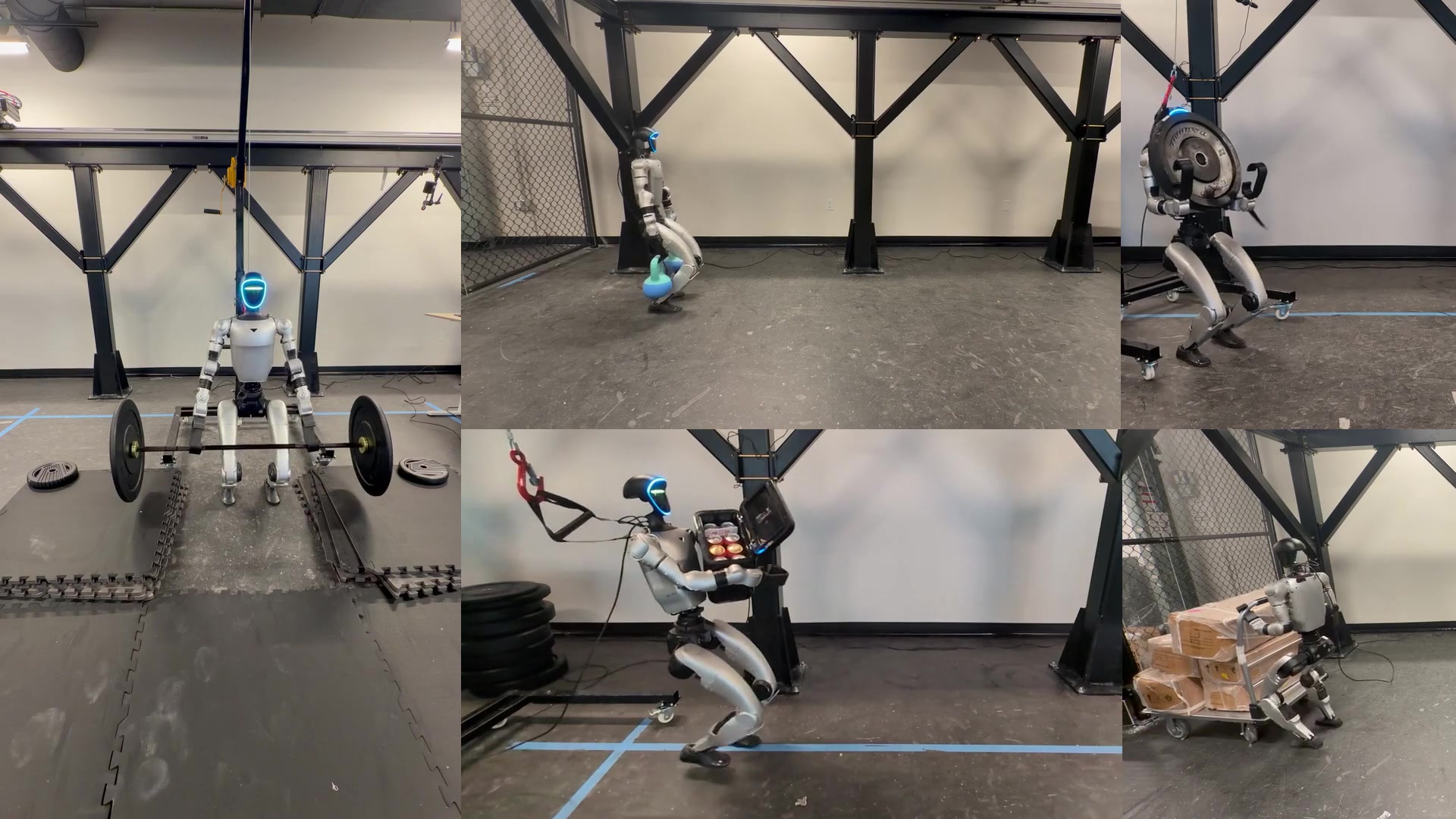
HULK evaluates one distilled controller across several load geometries rather than one fixed lift. Source: the authors' official project page and paper experiments.
A payload is part of the dynamics, not background noise
An unexpected shove and a carried fridge can both move a robot towards the edge of support, but they are different control problems. A shove is transient. A payload keeps applying gravity and contact forces for the duration of the task. When the robot raises an arm, turns, or presses the object into its torso, the same mass produces a different moment about the robot's centre of mass.
That geometry explains why arm control and walking cannot be separated cleanly. A wrist target that is easy with empty hands may be infeasible under load. A footstep that preserves commanded speed may leave too little balance margin. Compliance alone is also insufficient: yielding can reduce an incidental impact, but it cannot remove the need to support a heavy object against gravity.
HULK therefore treats the external wrench as an input to the balance problem. Its model-predictive controller forecasts loaded centroidal motion—centre of mass, pelvis rotation, contact forces, and interaction forces—over a short horizon. Those predictions guide the reward used to train the learned controllers. The MPC is not the deployed controller; it is a training signal that says what dynamically consistent motion under load should resemble.
This distinction matters for evidence. The paper does not show a general-purpose robot reasoning about any unseen object. It shows a low-level whole-body policy learning from simulated load conditions and then executing four defined hardware task families.
Two teachers divide a problem one policy must execute
One training distribution cannot easily cover every useful interaction. HULK trains two specialist teachers:
- The wrist-force teacher tracks arm poses and motion commands while forces act at the wrists. It learns to preserve commanded motion and recover balance under sustained loads and torso pushes.
- The whole-body-grasp teacher walks while maintaining established grasps on several objects. It sees payloads supported at the wrists and against the torso.
Both teachers receive force-aware predictive guidance, but their interaction data differ. The authors then use policy distillation with DAgger: a student visits its own simulated states, the teacher selected for that mode supplies a target action, and the student learns the shared command interface. The final student, not either specialist teacher, is what the hardware table evaluates.
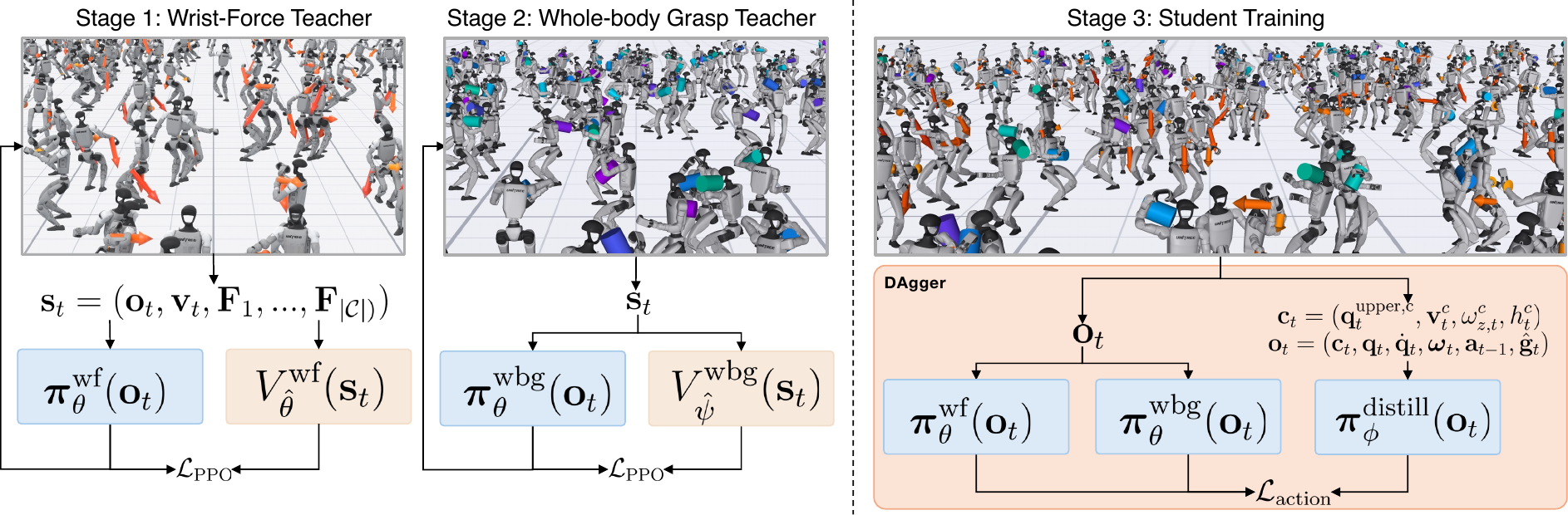
The teacher actors and student use deployment observations, while privileged state is available to the training critics. The student is supervised on states it visits through DAgger. Source: HULK method and paper Section III-G.
The split is more than an architectural flourish. The force teacher supplies recovery and arm-tracking behaviour without needing to solve grasp acquisition. The grasp teacher supplies object-supported walking without being responsible for every disturbance pattern. Distillation asks one network to reproduce both local competencies while keeping a common set of planar velocity, base-height, torso, and arm commands.
It also creates a limitation. A student can only combine what its teachers cover. HULK starts the grasp teacher from established grasps and samples static arm poses for the force teacher. Picking up an object, changing the grasp, and handling fast contact transitions remain outside the demonstrated scope.
The balance signal includes velocity, not only position
Keeping the vertical projection of the centre of mass inside the feet can describe a static pose, but it misses where the robot is already moving. HULK instead builds its barrier around the planar divergent component of motion, which is equivalent to the instantaneous capture point under the paper's constant-height linear-inverted-pendulum assumptions.
The capture point combines centre-of-mass position and velocity. Informally, it asks where support would need to act to arrest the simplified model's divergent horizontal motion. HULK shifts that point to account for the external wrench and compares it with a tolerance-expanded region covering current foot contacts and predicted touchdown areas.
During training, a control barrier function corrects unsafe commands and penalises the size of that correction. The aim is to make the neural policy internalise better recovery behaviour. The exported policy then runs without the barrier solver.
This selected simulation comparison illustrates push recovery across five controllers. The quantitative test uses one-second pushes in three directions at six magnitudes from 50 to 130 N. Source: the HULK results page.
That deployment detail changes how the result should be described. The training-time barrier improves the learned response; it does not provide a runtime safety guarantee. State-estimation error, unseen contacts, actuator saturation, and dynamics mismatch can still put the hardware outside the safe set the training signal tried to encode.
What the simulation comparison establishes
The paper tests fixed policies under identical commands and perturbation schedules on the same simulated platform. Each displayed mean and sample standard deviation aggregates five evaluation seeds; those seeds vary evaluation inputs, not policy training.
For loaded tracking, the test applies 10 kg at each forearm, ramps the load over two seconds, waits another two seconds, and then commands one velocity axis. A separate standing test applies one-second torso pushes from the front, rear, and side. Each HULK force teacher is evaluated on 90 push episodes.
| Simulation measure | MPC-guided teacher | Teacher with capture-point barrier | What can be concluded |
|---|---|---|---|
| Forward velocity error at 10 kg per arm | 0.242 ± 0.009 m/s | 0.210 ± 0.007 m/s | Lower in the reported loaded-tracking setup |
| Lateral velocity error at 10 kg per arm | 0.257 ± 0.004 m/s | 0.142 ± 0.003 m/s | The largest reported tracking improvement |
| Mean worst DCM margin | −0.251 ± 0.011 m | −0.162 ± 0.012 m | Smaller excursion outside the benchmark envelope, but still negative |
| Largest push survived in every direction | 110 N | 130 N | Higher tested disturbance threshold |
These are author-reported results, not independent replication. The comparison also contains a trade-off: at non-zero random wrist forces, the barrier-trained teacher has higher composite root-tracking error than the authors' teacher without the barrier. The paper's own interpretation is the useful one—preserving balance may require accepting some motion error rather than tracking every command rigidly.
The hardware evidence is real but narrow
The distilled student is deployed on one Unitree G1 and compared with AMO, FALCON, and Thor. All four tasks require walking. Cart pulling and payload carrying load the wrists; fridge and canister carrying also put the object against the torso.
At a shared fixed load, HULK completes five of six 150 kg cart trials, four of four 11 kg payload trials, four of four 6 kg fridge trials, and four of four 5 kg canister trials. A trial fails after a fall, joint-torque protective stop, or dropped object; the payload test also requires staying within an OptiTrack-measured path threshold. In separate load sweeps, the largest completed loads reported for HULK are 300 kg for the cart, 12.25 kg for the payload, 7 kg for the fridge, and 6.1 kg for the canister.
The 300 kg figure is the cart's load, not a measured pulling force, and comes from a separate maximum-load sweep rather than the six-trial 150 kg comparison. Source: the HULK hardware results and paper Section IV-C.
The maximum-load clips are compelling demonstrations, but they should not be turned into a reliability percentage. The common-load trial counts are only four or six per method and task. The paper does not report broad environment variation, unseen-object evaluation, or long-duration deployment. “Zero-shot” here means the policy transfers from simulation to this hardware test without real-world training; it does not mean zero setup, calibration, or task-specific evaluation apparatus.
Fridge carrying changes the load geometry by adding torso contact. HULK completes four of four reported trials at the shared 6 kg load; that result does not establish arbitrary-object generalisation. Source: the official comparison gallery.
Forceful control needs load-aware training records
HULK is a control study, not a released training dataset. As reviewed on 16 October 2026, the official project page exposes the paper, figures, videos, benchmark tables, and interactive browser demos, but labels code as coming soon and does not link a downloadable training corpus. The method is inspectable; the full training pipeline is not yet reproducible from released artifacts.
Its data design is still instructive. A useful forceful-loco-manipulation record must preserve more than joint positions and a success label. At minimum, it should distinguish:
- commanded planar motion, torso pose, arm targets, and the action actually sent;
- external wrench magnitude, direction, point of application, and whether the object also contacts the torso;
- object mass, geometry, grasp state, and the support contacts active at each time;
- measured or estimated joint state, base motion, centre of mass, foot contact, and centre of pressure;
- the balance quantity used for training or evaluation, including its model assumptions and support region;
- safety stops, falls, drops, path deviations, interventions, and the controller version that produced them.
Without the point of application, “10 kg per arm” cannot explain the moment imposed on the body. Without the active support region, a DCM margin has no geometric reference. Without separating a training-time correction from the deployed command, logged behaviour can falsely suggest a runtime filter that was never present.
This complements the site's article on robot play and contact response. ForceWAM asks how a manipulator learns local visual-force consequences. HULK asks how a floating-base robot keeps the resulting load compatible with whole-body balance. They are adjacent questions, not duplicate answers.
The missing transitions define the next problem
HULK's strongest contribution is to make sustained load part of the learned balance problem. Force-aware prediction gives each teacher a reference for loaded dynamics; capture-point guidance shapes recovery; distillation puts the specialists behind one interface; and the G1 tests show that the combination can move beyond simulation in four bounded tasks.
The paper is equally clear about what remains. Its centroidal predictor does not resolve every joint's actuation feasibility. Grasps are established before the carrying controller takes over. Grasp acquisition, regrasping, rapid contact changes, arbitrary load placement, and runtime safety filtering are not demonstrated.
So the practical answer is conditional. A humanoid can carry heavier loads without simply fighting every disturbance when training represents the load's geometry, its effect on balance, and the motion errors worth tolerating. But a clean carry starts after the hardest transition—making and changing contact—and HULK does not yet close that gap.