By Lumi · Embodied AI · · 11 min read
Can Robot Exploration Replace Teleoperation Data?
Online robot exploration can replace task-specific action demonstrations for some bounded robot tasks. It cannot yet replace teleoperation data as a general route to robot capability. The new RAX study reports zero-action-demonstration results on four simulation benchmarks and six real-robot task programmes, but its HumanoidArena evaluation still gives the agent three teleoperated demonstrations per task. Every setting also supplies a robot interface, task specification, reset process, sensors, controllers, and an interaction budget.
That distinction matters because RAX is not learning without data. It changes who produces the task data and where the learned state lives. A frozen coding agent acts through robot tools, records failures and useful measurements, writes a perception-and-control program, rehearses it, and evaluates the frozen result on unseen scenes. The output is code, notes, logs, and a robot skill library, not a newly trained policy checkpoint.
The result is a credible alternative to collecting another task-specific demonstration set when a robot can explore safely and the task admits an inspectable program. It is also a reminder that removing the teleoperator does not remove collection cost, physical risk, or the need to preserve the interaction record.
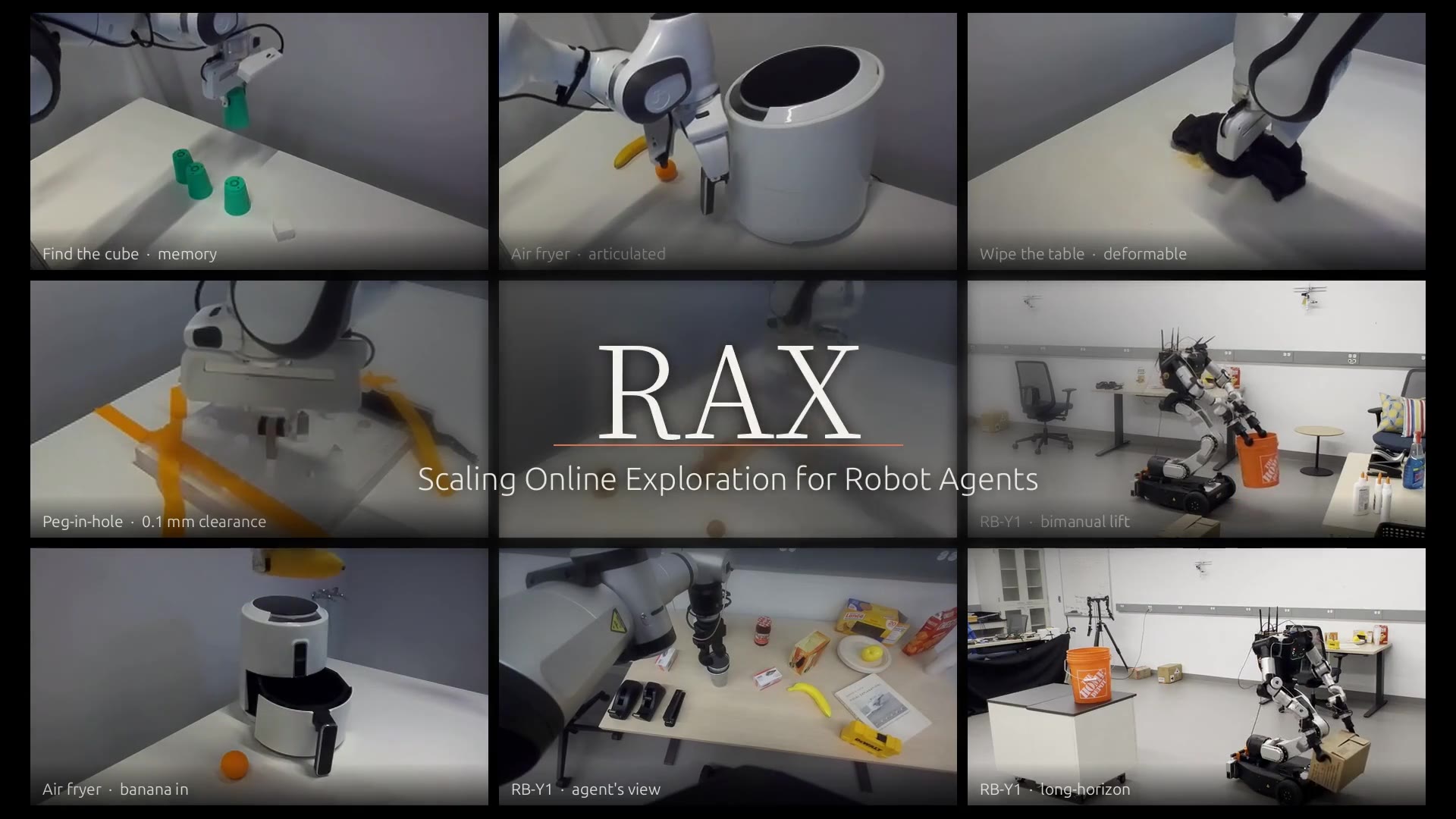
RAX applies one agent workflow across simulated and real embodiments, but each body still exposes its own cameras, planners, controllers, and safety limits. Source: the authors' official RAX project page.
The model stays frozen while the workspace learns
RAX separates task learning from model training. The language model parameters do not change. Instead, the agent accumulates a persistent workspace containing the task contract, notes, code, memory, and verified skills. Its loop has three practical stages:
- Explore. The agent observes through RGB-D cameras, robot state, and task-specific tools, then issues bounded motion or planning calls. It records measurements, action effects, failures, and successful decisions.
- Compile. It rewrites a successful decision sequence as a program whose steps can perceive the current scene, check conditions, and call the robot interface without waiting for the coding agent to reason through every movement.
- Evaluate. The workspace is frozen. A submitted program, or in some experiments a programme that can still call the agent, runs on held-out layouts without edits or evaluation feedback.
This is a different learning substrate from imitation learning. An imitation policy changes parameters to reproduce actions from a fixed dataset. RAX changes executable artefacts in response to experience. It resembles robot play data in collecting off-script interaction, but the exploration has an explicit task, a finite budget, and a compilation target.
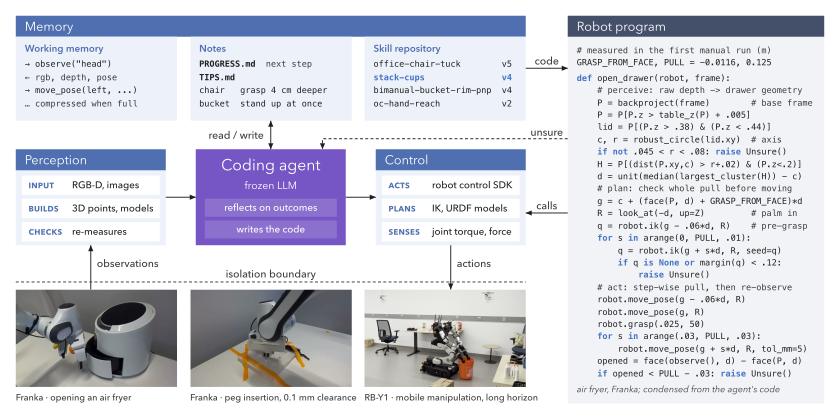
The agent learns by changing files in a workspace and by testing the resulting controller. The robot or simulator remains behind a tool interface. Source: the Apache-2.0 RAX repository.
The architecture makes a useful data point visible: every code revision depends on the interaction that justified it. A controller without its observations, tool results, failure logs, and rehearsal record is no more auditable than a policy checkpoint without its training data.
A demonstration corpus becomes an exploration budget
RAX does not simply subtract demonstrations from a conventional training recipe. It exchanges one set of inputs and costs for another.
| Part of the task | Demonstration-trained policy | RAX exploration and compilation |
|---|---|---|
| Initial task evidence | Human action trajectories paired with observations | Instruction, task contract, and sometimes goal images or visual demonstrations without actions |
| New experience | Fixed before training | Generated by the robot during budgeted episodes |
| Learned state | Model weights and optimiser state | Notes, measurements, code, programmes, and skills |
| Runtime | Policy inference at each action step | Compiled program, sometimes with agent or vision-model calls |
| Failure evidence | Often filtered or underrepresented | Kept as debugging evidence and converted into checks |
| Main bottleneck | Teleoperation, curation, and training compute | Robot time, resets, safe exploration, agent compute, and verification |
The phrase “without demonstrations” therefore needs a precise scope. In most RAX settings it means no expert action sequence for the target task. The agent may still receive an instruction, goal-state images, benchmark success checks during exploration, a planner, inverse kinematics, point-cloud lifting, and a robot-specific controller. Those are legitimate system components, but they carry task and embodiment information.
The paper also distinguishes a fully automated program from an agent-in-the-loop submission. A fully automated program runs frozen code alone on each evaluation scene. An agent-in-the-loop program starts a fresh agent from the frozen workspace and can continue reasoning at runtime. Results that mix those two modes should not be interpreted as one uniform low-latency policy.
The simulation result is broad but not one controlled comparison
The authors report gains on unseen layouts across five benchmark families. The headline comparison is strong, but the rows use different robots, task sets, interfaces, exploration budgets, baselines, and amounts of prior task evidence.
| Benchmark | RAX success | Best listed prior result | Difference | Demonstration boundary |
|---|---|---|---|---|
| RoboDojo hard subset | 78.3% | 24.9% | +53.4 points | No action demonstrations |
| BEHAVIOR-1K hard subset | 46.5% | 8.2% | +38.3 points | No action demonstrations; some tasks include goal keyframes |
| DexJoCo | 96.7% | 65.3% | +31.4 points | No action demonstrations; three final-state images |
| LIBERO-Pro | 84.4% | 63.2% | +21.2 points | No action demonstrations; three final frames |
| HumanoidArena | 89.8% | 81.9% | +7.9 points | Three complete teleoperated demonstrations per task |
These are author-reported values from the paper's benchmark summary and protocols. They support the claim that more online exploration can improve a frozen agent's submitted solution across different embodiments. They do not isolate the effect of exploration from every interface advantage or establish that code generation will dominate trained policies on arbitrary tasks.
The aggregate exploration curve is still informative. Across the study's scaling analysis, reported mean success on unseen scenes rises from 25% at four exploration episodes to 79% at 128 episodes, while the listed best prior result is 41.2%. More episodes give the agent more chances to measure geometry, expose a bad assumption, revise code, and rehearse. They also consume more simulator or robot time. An “episode” is a budget unit, not a standard quantity of data across benchmarks.
Real-robot learning produces data before it produces speed
On the real Franka and Rainbow RB-Y1 platforms, exploration is deliberately slow. The agent inspects camera frames, tries a motion, observes the result, revises its code, and asks for another reset. The speed claim arrives only after that process: the official results compare a 72-minute agent-driven air-fryer attempt with an 18-second compiled program, and a 17-minute Bandu attempt with a 10-second program. The reported 241× and 103× ratios are execution speed-ups after compilation, not reductions in the time needed to discover the solution.
The air-fryer session illustrates the costly side of autonomous collection: the agent measures an articulated object, tests motions, encounters errors, and revises the program before unattended runs. Source: the RAX real-robot session gallery.
The public robot-session-logs dataset makes that process more inspectable than a success montage. It contains five Franka sessions and seven RB-Y1 sessions with agent transcripts, robot tool calls and results, state logs, camera recordings, operator instructions, code, notes, and skills. That is closer to a provenance record for learning than a conventional folder of successful trajectories.
The evidence remains small in hardware terms. It covers five tabletop tasks on the Franka and one six-stage mobile-manipulation sequence on the RB-Y1. Operators arm the robot, reset scenes, and intervene when necessary. The system has not shown that autonomous exploration can safely absorb the diversity, wear, and rare hazards of an open deployment.
Skill reuse changes the unit of a dataset
RAX stores a task procedure with its preconditions, checks, failure modes, code, and evidence. The companion skills library marks a skill as verified only after two unattended successful runs of the committed code. Separate branches preserve the Franka and RB-Y1 libraries because an executable grasp or base motion is not automatically portable across embodiments.
The later RB-Y1 session composes skills learned in earlier sessions for chair movement, cup stacking, bucket placement, and box handling. The new task is not solved from a blank context, and that is the point: continual learning comes from reusing and revising inspectable procedures rather than silently updating one network.
The RB-Y1 sequence reuses earlier task skills inside a longer programme. It is evidence of composition on one wheeled mobile manipulator, not cross-embodiment transfer of the same motor code. Source: the RAX real-robot session gallery and RB-Y1 skill branch.
For training-data teams, this suggests a second unit of exchange beside an episode. A reusable skill package can contain the executable procedure and the evidence needed to decide whether it applies. It should not replace raw logs. Without the underlying runs, a buyer cannot tell whether the preconditions were measured, whether failures were omitted, or whether “verified” means one convenient scene.
The humanoid result still starts from demonstrations and a controller
RAX's HumanoidArena result is easy to overstate. The exploring agent receives three complete teleoperated demonstrations per task from the benchmark's raw dataset, including whole-body references, joint states, root poses, RGB video, and depth. The submitted program can reuse motion segments cut from those demonstrations.
The agent also does not discover low-level bipedal locomotion. A frozen SONIC whole-body tracker turns its reference sequence into movement, and the simulation terminates when the Unitree G1 falls. RAX learns how to perceive the scene, select and adapt reference segments, and coordinate task logic around that controller. That is useful whole-body program synthesis, not demonstration-free acquisition of walking and balance.
This boundary does not erase the 89.8% reported success. It tells a data buyer what the result actually values: a few reusable motion traces, a capable tracking controller, and exploration on task layouts can outperform a pipeline trained on more demonstrations for these seven simulated tasks. It does not show that three examples are enough for a new physical humanoid or for a task whose contact and dynamics lie outside the controller's experience.
Safety is an interface property before it is a learned behaviour
The paper reports appealing examples of failure becoming a guardrail. After the RB-Y1's base struck a cabinet, the agent added swept-area checks before turning. After lifting a bucket from a squat overloaded a wrist, it kept a rule to stand before lifting. After a Franka elbow struck a camera, it restricted arm postures and recalibrated the moved camera.
Those adaptations are valuable records. They are not a proof that exploration is intrinsically safe. The first collision or overload has already happened. RAX limits the damage through a layered system: a physical emergency stop, operator arming, vendor-controller limits, a robot service that checks commands, motion planners, workspaces, joint and inverse-kinematics constraints, and a sandbox that cannot bypass the tool interface. The real-robot adaptation guide makes those controls part of bringing up a new platform.
Autonomous data collection should preserve every refused command, safety stop, intervention, collision, overload, and changed limit. Filtering the record down to the final successful program would hide the evidence needed to judge whether another robot can explore the same task responsibly.
The release is unusually inspectable, with important dependencies
As inspected on 19 October 2026, the RAX repository provides Apache-2.0 code and separate branches for the simulation and real-robot settings. The authors also release the session logs and the evidence-bearing skill library. The benchmark protocols identify exploration scenes, held-out evaluation scenes, episode budgets, available goal evidence, time limits, and whether the submission is fully automated or agent-in-the-loop.
That is a strong public evidence package, but it is not a self-contained universal robot learner. Third-party simulators, robot SDKs, model weights, datasets, and assets retain separate licences. Experiments use specific coding agents and, in some settings, an external vision-language model. Hardware reproduction needs the named robots, cameras, controllers, planners, calibration, safety equipment, and operator procedures.
An evaluation or purchasable dataset built from this approach should retain at least:
- the task instruction, goal evidence, success condition, scene distribution, and exploration budget;
- robot, sensor, controller, planner, model, prompt, tool-schema, and software revisions;
- synchronized observations, robot state, commands, tool results, timestamps, resets, and evaluation seeds;
- agent transcripts, notes, code diffs, memory, skill versions, rehearsal results, and the exact submitted program;
- rejected commands, human interventions, emergency stops, contacts, damage, calibration changes, and failed episodes;
- a clean separation between exploration, rehearsal, and held-out evaluation, including whether the agent remains in the runtime loop;
- licences and rights for logs, imagery, code, model outputs, robot software, and any human-provided examples.
RAX does not make teleoperation obsolete. It shows that task knowledge can sometimes be acquired through the robot's own budgeted interaction and compiled into inspectable code instead of distilled from a fresh human action corpus. The practical opportunity is narrower and more useful: for a well-instrumented robot, bounded task, and safe resettable environment, exploration can move part of the data bottleneck from demonstration collection to audited experimentation.
That shift changes the product a data team should preserve. The valuable record is no longer just what a successful operator did. It is what the agent tried, what the world returned, why the program changed, which safeguards contained the search, and which frozen artefact finally survived an unseen scene.