By Lumi · Embodied AI · · 11 min read
Why Moving a Camera Can Break a Robot Policy
How can one robot policy keep working when a camera moves, disappears, or joins the sensor rig? VersaCamVLA answers by giving the policy a fixed-size summary of a variable set of calibrated views. The summary changes with the available cameras, but the visual interface presented to the action model keeps the same shape.
That is a more specific achievement than a camera-invariant robot. The authors report much smaller losses under unseen viewpoints, support three to six input views with one policy in simulation, and show the same idea on a dual-arm robot. The system still requires camera intrinsics and extrinsics, retains a native fixed-view input inside its base vision-language-action model, and has only been evaluated in tabletop manipulation. It changes how camera evidence reaches the policy; it does not make camera placement irrelevant.
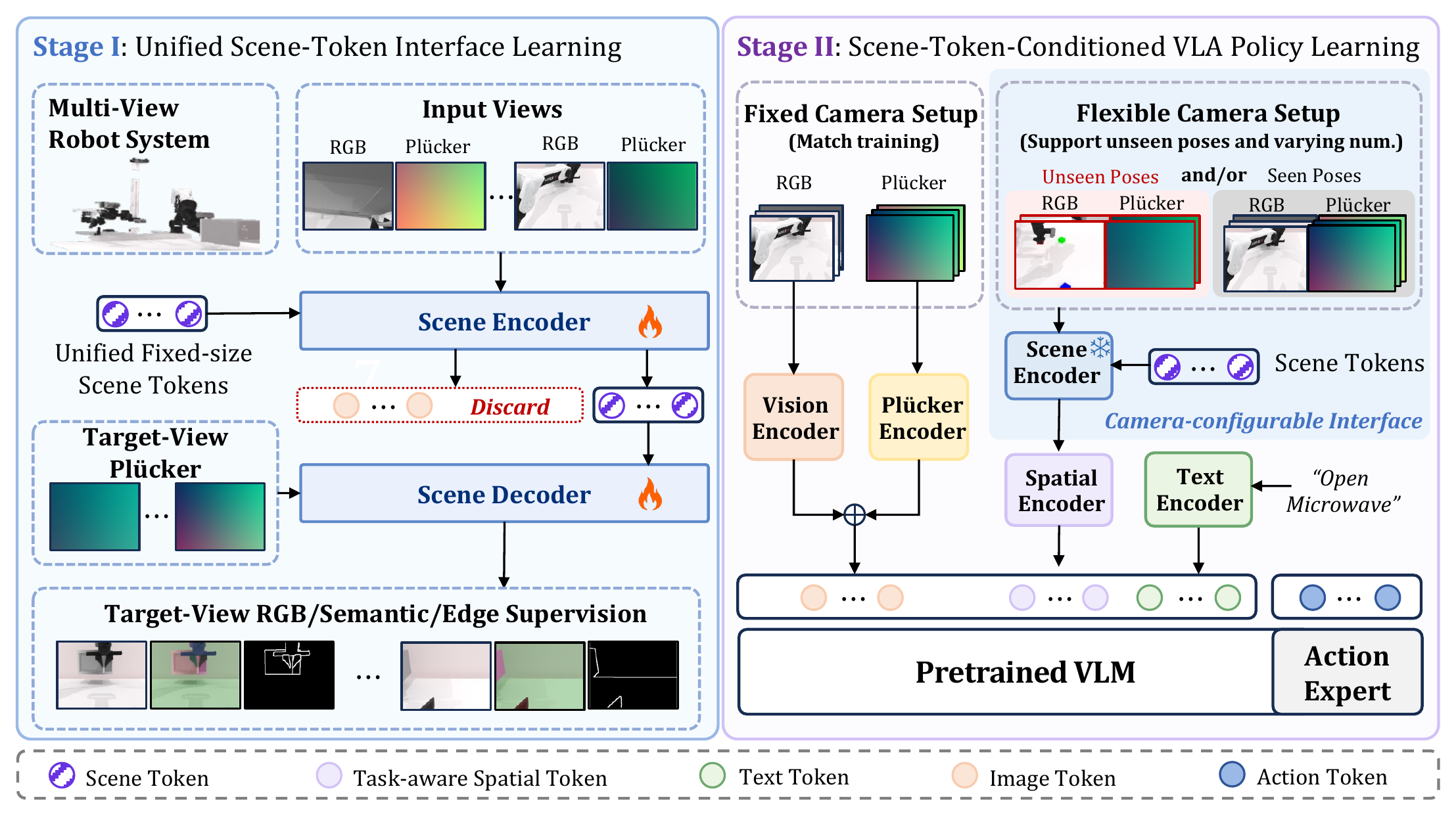
A training-only decoder teaches the scene tokens to preserve view-consistent information. The deployed policy keeps the encoder and a compact spatial adapter, not the image-prediction heads. Source: the authors' VersaCamVLA method figure.
A moved camera changes the model input
A person can often recognize the same worktop from another corner. A policy does not receive “the worktop” as an abstract object. It receives pixels arranged into tokens by a camera-specific path. Move the camera and objects change scale, occlusions change, backgrounds move, and a gripper may enter the frame from a new direction. Add a camera and a conventional multi-view model may receive an extra block of tokens that its action layers never saw during training.
This explains why camera count and camera pose are separate tests. A four-camera rig in a new arrangement preserves the number of image streams but changes their geometry. A six-camera rig at familiar viewpoints changes the input set and compute load. Success in one condition does not establish robot generalization in the other.
The site's LIBERO-Plus analysis already shows why this matters: moving a camera can expose a severe benchmark weakness, and a stable wrist view can hide some of the loss. VersaCamVLA asks the next question. Instead of only measuring the failure, can the visual interface be trained so one action policy accepts a changing set of views?
The policy sees a fixed-size scene summary
VersaCamVLA is trained in two stages. In the first, a scene encoder receives a non-empty set of RGB images together with the rays implied by each camera's calibration. It always emits 3,072 latent scene tokens, arranged as three 32 by 32 grids, regardless of how many views supplied the evidence.
A decoder then queries those tokens from target camera rays and predicts three signals: RGB appearance, semantic features, and edges. This target-view task is not part of robot execution. It is supervision intended to make the shared tokens preserve which objects and boundaries remain consistent across viewpoints. Once that representation is trained, the decoder and prediction heads are discarded.
In the second stage, a small spatial encoder compresses 3,072 scene tokens to 192 supplementary tokens for the pretrained π0.5 VLA. The authors keep π0.5's native visual, language, and proprioceptive inputs and add the compact scene pathway alongside them. This detail matters: the approach wraps a camera-configurable source around an existing policy rather than retraining the entire model to consume a different raw image sequence for every rig.
The fixed-size bottleneck also changes the cost curve. On one RTX 4090 at batch size one, the paper reports 231.20 milliseconds per inference step with four views, almost identical to the 230.93 milliseconds reported for the base model. Going from four to six views adds 7.06 milliseconds for VersaCamVLA and 29.47 milliseconds for the direct π0.5 comparison. These are authors' measurements on one implementation, not a deployment guarantee, but they show why separating view aggregation from action tokens can help.
Wrist motion becomes viewpoint training data
The representation still needs examples of camera movement. Static workcell cameras offer only a few poses, so VersaCamVLA uses Wrist-Augmented Pose Sampling, or WAPS. At each training frame, it varies the subset of static and wrist views given to the encoder while asking the decoder to predict every available view. As the wrist cameras move through demonstrations, they expose the representation to many more poses without collecting the task again from a moving external camera.
The ablation is useful but modest. On the paper's unseen-pose RoboTwin test, adding WAPS raises reported average success from 48.79% to 52.63%. It is evidence that the wrist trajectory adds useful viewpoint coverage; it does not mean arbitrary wrist motion covers every external-camera location. The simulation pool contains six environment and two wrist cameras, while the real setup uses four environment and two wrist cameras. A single-camera dataset cannot reproduce that cross-view supervision.
For data collection, this makes camera motion part of the episode rather than incidental metadata. The useful record includes the image, camera intrinsics, time-varying wrist-camera extrinsics, robot state, and a shared coordinate frame. If the image survives but the pose is dropped during export, the same demonstration can no longer provide the geometric relationship this training objective uses.

The evaluation changes azimuth, distance, and pitch around the workspace rather than merely applying image noise. Source: the paper's camera-pose evaluation.
The strongest result is the unseen-pose comparison
On 16 RoboTwin 2.0 tasks, π0.5 falls from 48.88% average success at its trained camera poses to 32.88% at perturbed poses. VersaCamVLA reports 53.44% at the seen poses and 52.63% at the unseen poses. Both methods use four views in that comparison, so the 19.75-point unseen-pose gap is not created by giving one model more cameras.
The perturbations change azimuth, distance, and pitch over a workspace-centred spherical region. In the largest reported azimuth band, from 60 to 90 degrees, VersaCamVLA reaches 53.38% and π0.5 reaches 30.06%. That is a controlled simulation result within sampled pose ranges. It does not cover arbitrary mounting height, lens choice, rolling shutter, missing calibration, motion blur, or a camera whose view is blocked.
The top row synchronizes head, wrist, and agent views; the red path marks the moving external camera. This is a simulated policy execution shown at four times speed. Source: the official camera-pose gallery.
The broader RoboTwin table needs a different reading. Across clean tasks, VersaCamVLA reports 52.56% average success against 35.88% for π0.5. Under the benchmark's domain-randomized appearance and scene changes, the figures are 23.00% and 21.63%. The narrow DR gap shows that camera configuration is not the only source of visual brittleness. A representation designed for posed views does not automatically solve texture, lighting, clutter, or every other distribution shift.
One policy accepts more or fewer cameras
The camera-count experiment holds viewpoints aligned and changes the number of inputs. The authors train separate π0.5 baselines for three and four views. They evaluate one VersaCamVLA policy with three, four, five, and six views, reporting 52.56%, 53.44%, 53.13%, and 55.63% average success. The matched π0.5 baselines report 35.88% with three views and 48.88% with four; five- and six-view baselines are not reported.
That result demonstrates interface flexibility, not that every extra camera helps. The five-view average is slightly below the four-view result, and a new camera is only useful if it contributes complementary, calibrated evidence. A poorly placed view can be redundant, occluded, delayed, or inconsistent with the other streams.
One policy is shown using three, four, five, and six views. The input panels and external-camera trajectories make the configuration change visible. Source: the official camera-count comparison.
This flexibility is especially relevant to robots that cannot share one camera rig. A mobile manipulator may lose a wall-mounted view outside one workcell. A humanoid's head and wrist cameras move with its body, while a fixed safety camera may appear only at some stations. A useful multi-robot dataset should therefore record which streams were present on each step, rather than padding every episode until it resembles one supposedly standard rig.
Calibration becomes a policy input
VersaCamVLA does not infer where each camera is from RGB alone. It requires sensor calibration: intrinsics describe how image pixels relate to rays, while extrinsics place those rays in a common spatial relationship. The encoder represents source pixels with Plücker rays derived from that geometry, and the decoder uses target rays when learning to predict other views.
The paper tests static errors in the supplied extrinsics. In RoboTwin, clean calibration gives 52.56% average success. Gaussian biases with per-axis standard deviations of 20 millimetres and 2 degrees produce 52.13%; 50 millimetres and 5 degrees produce 50.38%. Those results suggest tolerance to the sampled biases, not permission to skip calibration. The noise is fixed within each episode, simulation supplies the reference geometry, and the study does not cover drifting mounts or incorrect synchronization.
This changes the deployment contract. A data loader must pair every frame with the calibration version that applied at that time. A camera remount should create a new extrinsic record. A wrist camera needs a transform derived from the robot's measured kinematics for each step, with timestamps aligned to the image. The existing camera-and-action timing guide covers the temporal half of that problem; VersaCamVLA makes the spatial half directly visible to the learned policy.
Real-robot evidence is promising but narrow
The hardware study uses a Cobot Magic, or Mobile Aloha, dual-arm platform. The authors collect 50 human-teleoperated demonstrations for each of three tasks: passing and placing a cube, stacking three cubes, and handing over then inserting a test tube. Each reported condition uses 20 evaluation trajectories per task.
With four views at the trained poses, π0.5 averages 41.67% and VersaCamVLA 53.33%. At unseen poses, π0.5 falls to 13.33% while VersaCamVLA reports 58.33%. With one additional test-time camera, the same VersaCamVLA policy rises from 53.33% at four views to 65.00% at five. The comparison supports the camera-configurable interface on real hardware, but 60 trials per condition across one platform are not a reliability estimate for humanoids or production cells.
The bimanual handover-and-insertion task requires a precise view of the tube and rack. The clip is an official demonstration shown at four times speed, not an independent test. Source: the VersaCamVLA real-world gallery.
The hardest hardware task remains hard. π0.5 records no successful insertions with four views; VersaCamVLA reports 20% at the seen pose, 35% at an unseen pose, and 45% with five views. More geometric evidence appears useful, but more than half of the reported five-view trials still fail. A strong average should not hide that task-level limit.
What a camera-configurable dataset must preserve
The paper suggests a practical data specification beyond “multi-view RGB”. For every episode, retain:
- each raw stream's camera identifier, intrinsics, distortion model, resolution, and exposure settings;
- time-indexed extrinsics in a named world, robot-base, head, or wrist frame, with the transform chain and calibration version;
- image-acquisition time, robot-state time, interpolation rules, dropped frames, and a per-step mask for cameras actually present;
- robot embodiment, proprioception, language instruction, commanded action, measured outcome, and success definition;
- which views trained the scene representation, which views trained the action policy, and which poses and camera counts were held out for evaluation;
- remounts, impacts, recalibration events, pose uncertainty, and trials where a view was occluded or unavailable.
This record lets a buyer distinguish three claims that are often collapsed. Multi-view training means several cameras were used. Unseen-pose testing means camera locations were held out. Variable-count testing means one checkpoint accepted different numbers of views. None of those facts alone proves the other two.
The release still has important boundaries
VersaCamVLA was submitted on 8 October 2026 and accepted at NeurIPS 2026, but its official repository currently says the code is coming soon and exposes no licence file. The paper and project page provide unusually detailed tables and media; they do not yet provide a runnable implementation for independent reproduction.
The method assumes calibrated cameras, manual placement, and a tabletop bimanual workspace. It does not choose the next best viewpoint, recover from a camera that moves without an updated transform, or prove safety under a large configuration error. The authors explicitly identify uncalibrated cameras, active viewpoint selection, and mobile workspaces as future work.
For a humanoid team, the useful lesson is not to declare the camera problem solved. It is to treat the camera set as a changing observation source with an explicit geometric contract. A fixed-size scene interface can prevent every new rig from becoming a new action-model shape, while held-out pose and count tests reveal whether that flexibility is real. The remaining decision is operational: preserve the calibration and availability records needed to know when the policy is still inside the conditions it was actually tested on.