By Lumi · Embodied AI · · 31 min read
Applications of Humanoid Robots: What Is Working in 2026
Humanoid robots are already used for material handling, production-part positioning, warehouse tote transfer, hospital logistics and guidance, hotel check-in, public information and robotics research. They are also being tested for hazardous maintenance, disaster response and household chores. The strongest practical evidence comes from factories, warehouses and non-clinical hospital deliveries. Home robots from 1X and Sunday Robotics are much more capable than an isolated lab trick, but they remain early-access or pre-deployment products rather than established domestic appliances.
That answer is less cinematic than the usual promise of a tireless mechanical colleague who can do every unwanted job. It is also more useful. As of 8 August 2026, a real humanoid application usually means a robot repeating a bounded task in a prepared part of a live site, with people, conventional automation and remote support around it. The home is the important exception: there the entire point is to cope with variation, which is why impressive home demonstrations need more scrutiny, not less.
Agility Robotics' Digit makes the distinction concrete. At a GXO facility in Flowery Branch, Georgia, Digit takes totes from autonomous mobile robots and places them on a conveyor. GXO moved from a 2023 proof of concept to a multi-year commercial Robots-as-a-Service agreement in June 2024. Agility then reported that the deployment had moved more than 100,000 totes by November 2025. It is a narrow job, but narrow work done repeatedly is an application. A robot folding one carefully arranged shirt for a launch video is a demonstration.

Digit's commercial GXO deployment passed 100,000 totes moved in 2025, according to Agility Robotics. Source: Agility Robotics.
I use “humanoid” here for robots with enough of the human body plan to work in human spaces, including wheeled mobile manipulators, social robots and machines with simplified hands. The guide to what a humanoid robot is explains that boundary in detail. The more important question in this article is whether the human-like form produces useful work outside a staged demo.
How I rank the evidence
The word “application” gets stretched until a research clip, a signed agreement and a year of daily operations all sound equivalent. I separate them by operational maturity.
A commercial deployment has a customer using the robot in regular operations under a contract. An operational pilot puts the robot inside a live workflow for a limited period or task. A field trial tests feasibility, safety or human response in a relevant setting. A laboratory demonstration proves that a capability can work under test conditions. An announced plan proves only that somebody has a calendar.
Each stage is legitimate. The problem begins when a planned 2028 Atlas factory rollout is presented as work being done today. The International Federation of Robotics' 2025 assessment was blunt: commercial deployments were still few, batteries did not last a full working day, and humanoids did not match conventional industrial robots for speed, precision, reliability or repeatability.
I therefore look for five things: a named site, a defined task, a deployment status, a time period and an operational result. Numbers published by the robot maker still need a label. They are evidence, but they are not an independent audit. When a source gives no uptime, intervention rate, failure count or cost, I do not quietly invent them.
By that test, the application areas look like this:
- Factories and warehouses have bounded live deployments for tote transfer, part positioning, line feeding and material handling.
- Hospitals use humanoid-form mobile manipulators for non-clinical deliveries; direct care and rehabilitation remain supervised.
- Hotels and public venues use social humanoids for check-in, directions, information and entertainment.
- Universities use humanoids as research instruments for locomotion, manipulation and robot learning.
- Homes have credible autonomous task demonstrations and 2026 beta programmes, but no verified mass-market deployment.
- Hazardous work is mostly proof-of-concept research, while specialised quadrupeds and remote manipulators already do operational jobs.
- Space has historical on-orbit humanoid experiments, not a current autonomous humanoid workforce.
Industrial applications: factories and warehouses
Industrial sites are the obvious starting point because they are controlled without being laboratories. Floors are mapped, parts are standardised, access can be restricted and maintenance staff are nearby. Repetitive lifting also gives a buyer a measurable problem rather than a vague desire to “use AI”.
Factory production and intralogistics
BMW provides the clearest customer-published manufacturing figures. During a ten-month Figure 02 pilot at Plant Spartanburg in 2025, the robot removed sheet-metal parts and positioned them in fixtures for conventional welding robots. BMW says Figure 02 moved more than 90,000 components, took about 1.2 million steps and operated for roughly 1,250 hours, supporting production of more than 30,000 BMW X3 vehicles. “Supporting” matters: the humanoid did not build 30,000 cars. It performed one upstream handling step repeatedly.
Those figures do not reveal the achieved intervention rate, failure count or economics, but they are far stronger than a successful afternoon in a test cell. They also show why the first factory applications are unglamorous. Removing a part from a rack, turning it into the correct orientation and loading a fixture is physically awkward, easy to measure and already connected to a mature automated process.
In June 2026, BMW announced the next task. Figure 03 would pick unsorted components from larger containers and arrange them in a sequencing trolley at Spartanburg before conventional transport robots carried the trolley to assembly. The BMW description of the sequencing workflow shows where humanoids may fit: variable handling at the messy edge of an otherwise automated system.

Figure 03 demonstrating BMW's 2026 logistics-sequencing use case at Plant Spartanburg. Source: BMW Group PressClub.
BMW Group footage of Figure 03 performing the Spartanburg sequencing workflow in 2026. Source: BMW Group.
Longcheer Technology has published another unusually detailed customer account. It integrated AgiBot's G2 into a tablet-testing line in Nanchang on 16 March 2026. By 15 April, Longcheer reported more than 200 operating hours, average runs above ten hours per day and a 4% downtime-loss rate. The robot picked tablets from a conveyor, placed them in test fixtures, exchanged data with the test equipment and sorted finished and non-conforming units.
The programme then expanded from one station to eight G2 robots. During a 23–28 June livestream, Longcheer says the fleet completed 64 hours of pick-and-place, transfer and sorting with zero interruptions and 99.99% operational success. This was joint development on a real production line, not an arm's-length robot purchase, and the published material does not define the success denominator, human recoveries or ROI. It is still valuable live-production evidence.
Siemens reported a shorter but well-specified test in April 2026. A wheeled HMND 01 Alpha autonomously picked, transported and placed totes at the Siemens electronics factory in Erlangen. Siemens published target results of 60 tote moves per hour, more than eight hours' uptime and above 90% autonomous pick-and-place success. The release does not state the overall trial duration, interventions or economics, so I count it as operational testing rather than a commercial deployment.
Other factory programmes cover the same family of work. Apptronik and Mercedes-Benz identified assembly-kit delivery, tote movement and initial component inspection as potential Apollo applications. Apptronik says its customer-site training environments, including Mercedes-Benz, use teleoperation and autonomous execution to collect data for later commercial robots. That is a reminder that “deployed at a factory” may still mean task development rather than useful autonomous output.
Schaeffler reported in February 2026 that three Digit robots were being used for material handling and logistics in its US plants. Toyota Motor Manufacturing Canada signed a commercial agreement after a successful pilot, but its announcement described planned deployment rather than published production results. BMW's Leipzig programme similarly moved from laboratory work towards a 2026 pilot in high-voltage battery assembly and component manufacturing with Hexagon's wheeled AEON.
The factory use cases now being tested cluster around a short list:
- Feeding lines with totes, kits and components
- Sorting mixed parts into production sequence
- Loading and unloading fixtures, racks and machines
- Moving material between workstations
- Performing initial visual or sensor-based quality checks
- Handling repetitive work at low, high or otherwise awkward reaches
I would not count a production plan as a production application. Hyundai says Atlas will begin parts sequencing at its Georgia metaplant in 2028, with component assembly targeted for 2030. Tesla's Q1 2026 update described Optimus production lines and future capacity, but did not publish an operational fleet size, intervention rate or factory output attributable to the robots. Both programmes may become important; neither should be used as evidence of scaled factory work in August 2026.
Factory tasks create repeated demonstrations, corrections and failures that can be captured through human operation and autonomous runs. The resulting observations, states, actions and outcomes become the humanoid robot training data needed to teach the next part, rack or station. A factory is therefore both an application site and a data engine.
Warehouses and fulfilment centres
Digit's GXO job connects two existing islands of automation. An autonomous mobile robot brings totes to the station; Digit unloads them; a conveyor carries them onwards. The legs are not the interesting part. The useful capability is moving between human-scale pickup and drop-off points while handling a payload and maintaining balance. That depends on coordinated perception and whole-body control, rather than a good walking gait alone.
Company-published time-lapse from Digit's 100,000-tote milestone at GXO. Source: Agility Robotics.
The GXO agreement matters because the customer crossed from a proof of concept into regular contracted operations. Agility's 100,000-tote count is vendor-reported, but the workflow, customer and site are public. In a June 2026 transaction announcement, Agility also said Digit had accumulated more than 65,000 operating hours across deployment commitments at nine customer facilities. I treat that as a company claim, not an audited reliability study, but it indicates that the GXO cell is no longer the only field programme.
Commercial does not yet mean barrier-free collaboration. In an August 2026 account of its deployment process, Agility said its fourth-generation Digit remained inside a sectioned-off workcell during both pilot programmes and full Robots-as-a-Service deployments. The company scheduled its first “cooperatively safe” model for 2027. That is a future claim, but the disclosure usefully describes today's operating boundary.
Amazon illustrates the gap between testing and deployment. In October 2023 it began testing Digit at a robotics research site south of Seattle for empty-tote recycling. Amazon described the work as an initial use at an R&D facility. I found no authoritative follow-up showing Digit rolled out across Amazon fulfilment centres, so it remains a test rather than a production application.
Highline Commerce offers a different kind of evidence from a smaller operator. The fulfilment company says it became an alpha design partner for humanoid warehouse robots in 2025 and that the robots now fulfil up to 30% of its daily orders. “Up to” is not an average, and Highline publishes no order volume, error rate or intervention data. I would classify it as live operational testing, but it shows that warehouse work is expanding beyond moving identical empty totes.
The near-term warehouse jobs are tote transfer, empty-container handling, depalletising support, order consolidation and movement between equipment designed at different heights. Humanoids are unlikely to replace the fleets of mobile robots already moving shelves and pallets. Their opportunity is the manual hand-off between those systems.
The economic test remains unforgiving. If a fixed arm, conveyor or wheeled mobile robot can solve the task, it will usually be faster, simpler and easier to certify. A humanoid earns its complexity where the site is expensive to redesign, work happens across several human-scale stations, or one platform can cover enough changing tasks to offset its lower performance on each one.
Home and care applications
Homes and care settings are often grouped together because both involve helping people. Technically, they are very different. A domestic robot must manipulate an open-ended collection of objects in a changing private space. A hospital can assign a robot a fixed delivery route. A therapy study can constrain the conversation and keep a clinician present. “Helping at home” is therefore the broadest and least controlled application in this article.
Home chores: 1X NEO and Sunday Memo
A home contains children, pets, wet floors, glass, clutter, stairs and objects that nobody logged in an asset-management system. A household robot must understand an open-ended request, find the relevant object, move through several rooms, manipulate it without damage and recover safely when the plan fails. A warehouse can standardise a tote. A family is unlikely to standardise breakfast for the robot's convenience.
What 1X NEO is meant to do
1X positions NEO as a bipedal home robot for physical chores and conversational assistance. Its October 2025 product announcement names folding laundry, organising shelves and tidying spaces, while the current product page adds putting away dishes, opening the door, self-charging and scheduled chores. 1X lists a $20,000 Early Access purchase price and says US deliveries begin in 2026, with a $499 monthly subscription intended to ship later.
The hardware is designed around domestic constraints rather than factory speed. 1X says NEO weighs 66 lb, uses tendon-driven joints, has a soft outer body and runs for four hours. Its human-height, bipedal form aims at human-scale storage and movement, but the legs also make balance, energy use and fall safety harder than they are for a wheeled base.
The autonomy evidence is narrower than the marketing list. In March 2025, 1X and NVIDIA demonstrated a learned policy on the predecessor NEO Gamma that grasped a cup, transferred it between hands and placed it in a dishwasher in an employee's home. The task ran autonomously, but it was deliberately chosen as a first compatibility test for a new model and was trained over a week. It proved an end-to-end dish-loading behaviour, not autonomous management of an entire kitchen or the current production model's readiness.
1X's Redwood research expands the task shape. The company says the model jointly controls navigation and manipulation on NEO Gamma for retrieving objects, opening doors and moving through a home. It can choose a hand, brace against a surface and run onboard at about 5 Hz. Those are useful building blocks because household chores rarely begin with the object directly in front of the robot.
1X's company demonstration of Redwood controlling NEO for household mobile manipulation. The video also shows failed attempts, which is more informative than a perfect highlight reel. Source: 1X.
The January 2026 1X World Model evaluation provides a less flattering and therefore more useful picture. 1X ran 30 attempts per task on behaviours including steaming or ironing a shirt, opening a sliding door, using a watering can, scrubbing a dish, drawing and pouring cereal. The company says some dexterous tasks remained difficult; “pull tissue” succeeded 30% with one generated plan and 45% when choosing among eight. The model also took 11 seconds to generate five seconds of action, plus another second to extract controls. Longer-horizon replanning and recovery remained future work.
The most important product detail is Expert Mode. For a chore the robot does not know, a 1X Expert can remotely supervise its actions. The owner can also pilot NEO through a mobile or VR device. That may be a practical bridge to useful service, but it changes the application. A remotely guided robot is providing labour through a machine, not demonstrating general household autonomy. Camera access, scheduling, connectivity and the boundary between autonomous and human-guided work belong in any buyer's evaluation.
1X says an Expert session must be scheduled and approved by the owner and that NEO's ear rings visibly change while an operator is active. The owner can disable sharing task data for training. The public privacy policy does not specify default Expert-session recording, audiovisual retention, bystander consent or child-specific controls. With dual cameras, microphones, remote monitoring and a human support channel inside the home, those are product requirements rather than a generic privacy-policy footnote.
As of 8 August 2026, 1X's April factory update said current production robots were still being prioritised for employees and internal home testing. The company continued to promise first customer shipments during 2026, but I could not verify published results from ordinary Early Access homes. Its pre-order terms say the deposit places a customer on a waitlist and make no representation about when an order invitation will arrive. NEO is a real product programme with real hardware, pre-orders and household demonstrations. It is not yet evidence that a consumer can buy an autonomous general-purpose housekeeper.
What Sunday Robotics Memo is meant to do
Sunday Robotics made a different hardware choice. The company explicitly describes Memo's rolling base as an alternative to a bipedal humanoid shape. I include it as an adjacent anthropomorphic home robot because it has a human-scale torso, two arms and dexterous hands designed for the same tools and work surfaces. Discarding legs for chores on flat indoor floors is sensible engineering rather than a failure of anatomical ambition.
Sunday's technical page lists Memo at 170 lb. The low centre of gravity, passive stability, compliant arms and software speed limits reduce fall and contact risk, but this remains a heavy moving machine in a home. A wheeled base solves one safety problem; it does not remove the need for collision testing around children, pets and clutter.
Sunday's current application list is unusually specific. The company says Memo can clear plates, utensils and delicate glasses; discard scraps and napkins; load and run a dishwasher; pull an espresso shot; and fold laundry. The site shows uncut autonomous runs as well as accelerated clips. Memo is not for sale. A free, invite-only Founding Family beta is scheduled for late 2026. The November 2025 launch originally planned 50 households, although the current beta page does not restate the final cohort size.
Sunday's uncut company video of Memo clearing a table and loading a dishwasher. Source: Sunday Robotics.
Sunday's ACT-1 technical report puts numbers around the dishwasher run in the video. The company says Memo completed 33 unique and 68 total interactions with 21 objects while navigating more than 130 feet. In unseen Airbnb homes it received a 3D map to identify navigational context, and Sunday did not publish an aggregate success rate or number of homes. It is an unusually long autonomous sequence, but not yet a reliability study.
Sunday also takes a different route to training data. Its Skill Capture Glove records people performing chores in their own homes without requiring a robot at every collection site. The November 2025 company release reported about 10 million episodes from more than 500 homes. Sunday's product claim is that Memo does not need a human teleoperator watching through the robot inside the customer's home; training demonstrations are collected separately from participating “Memory Developers”.
That does not remove human support or privacy questions. Sunday's beta description says it will experiment with supervision, collaboration and fully hands-off operation. The company says customer-home behavioural data will be shared only with explicit consent, but its public privacy policy does not explain the remote-support interface, session logging, recording policy or robot-specific audiovisual retention rules.
The strongest Sunday result is laundry rather than dishes. In July 2026, Sunday reported that ACT-2 completed 778 of 785 autonomous folds, a 99.1% success rate across nine garment types. The company reported a median completion time of 2 minutes 13 seconds and mean fold quality of 4.72 out of 5. The evaluation used the same model checkpoint in unseen rooms with no per-home or garment-specific adaptation. The scope included common tops, trousers, leggings and shorts in varied sizes, materials and starting configurations. It excluded socks, underwear, bras and accessories, and the grading was performed through Sunday's own rubric and annotators.
That is serious evidence because Sunday published the attempts, scope, exclusions and adaptation cost. It is still company-run evaluation rather than an independent household deployment. Folding a declared set of garments on beds and folding surfaces also does not prove that Memo can collect a mixed laundry basket, identify ownership, choose whether an item should be hung or folded, and put everything away. The result moves laundry folding well beyond a one-take demo without turning Memo into Rosie the Robot.
Sunday says a hand-built Memo currently costs about $20,000 and expects scaled manufacturing to reduce that by at least half, but it has not announced a retail price. The late-2026 beta is the crucial next step. Reliability across 50 lived-in homes, maintenance incidents, user interventions and task completion over months will matter more than another funding round or faster montage.
The contrast between NEO and Memo is useful. NEO keeps legs and offers remote Expert support to broaden what the product can do early. Memo uses wheels and tries to arrive with a narrower set of autonomous skills learned from off-robot human data. Neither approach has yet proved a mass-market home service. Both are much more concrete than saying a generic humanoid will “eventually help around the house”.
Hospital logistics, rehabilitation and elder care
Healthcare is a real application area, but “robot nurse” is a poor description of the evidence. The strongest deployments move supplies. Other humanoids welcome people, provide directions, repeat information, lead structured exercises or support research into social interaction. They do not independently make clinical decisions, lift unpredictable patients or replace trained carers.
Cedars-Sinai provides a current operational example. In March 2026, the hospital said it was using three Moxi robots to move linen, retrieve lab samples and medication, and transport patient belongings. Moxi rolls on wheels and has one arm, a head and a torso, so it is a humanoid-form mobile manipulator rather than a biped. Its practical value is the delivery run that a nurse no longer has to make, not an attempt to imitate bedside care.
Diligent Robotics reported in February 2025 that its Moxi fleet had completed one million deliveries across 31 hospital partnerships. That is a vendor-published fleet total rather than an independent audit, but it establishes a much more mature application than a single hospital demonstration. The robot carries supplies, specimens and medicines through corridors and lifts while clinical staff remain with patients.
The EU-funded SPRING project tested PAL Robotics' wheeled humanoid ARI at Broca Hospital in Paris. The completed clinical study registration lists five uses: welcoming patients and families, giving infection-control reminders, helping people prepare for consultations, providing directions and offering entertainment while they waited. A March 2025 European Commission report says ARI interacted with more than 100 patients, companions and staff.
That trial also exposes the limits. It was exploratory and non-interventional, so it tested acceptability and use rather than improved health outcomes. Data-protection concerns kept ARI in a separate room and stationary. Researchers still had to improve speech recognition, gaze and multi-person conversation. Calling this an autonomous hospital worker would be creative accounting.
There is stronger evidence for a narrow companion role than for physical care. A 32-week randomised withdrawal trial placed the Kabochan humanoid companion with 103 residents with dementia across seven Hong Kong care facilities. The study found a moderate reduction in neuropsychiatric-related caregiver distress at week 16, while other health outcomes showed no significant between-group differences. The authors called for individualised care plans and continuous monitoring.
A separate trial with 33 care-home residents in England and Japan reported improved emotional-wellbeing scores after up to 18 hours of culturally adapted Pepper interaction, but did not find significant improvements in loneliness or physical health. A robot can prompt conversation and activity; it is not automatically an effective treatment for isolation.
Those studies support a bounded application: a humanoid can repeat prompts, demonstrate an exercise, offer structured conversation and give staff a consistent interface. They do not support unsupervised personal care. Bathing, transfers, medication decisions and emergency response combine high physical risk with clinical judgement, and current evidence is nowhere near replacing a trained carer.
I think the useful healthcare question is whether physical presence, gaze, gesture and repeatable conversation improve a specific non-clinical or therapeutic workflow enough to justify the privacy, supervision, infection-control and maintenance burden. That is a smaller claim than “robot nurse”, and current trials can actually test it.
Service, hospitality, retail and education applications
Service humanoids are often judged by the wrong standard. A hotel reception robot does not need to carry 20 kg or walk over rubble. It needs to attract attention, communicate clearly, connect to the booking or information system and remain available without creating more work for staff. The human-like face and gestures are part of the interface.
Hospitality and retail
Henn na Hotel Tokyo Ginza is a current example of a narrow commercial application. The hotel says two human-looking robots and human staff welcome guests. The robots provide multilingual reception while a kiosk handles payment and room keys. A June 2026 hotel update showed the reception robots still in service, dressed for a seasonal summer-festival display.
This is not an autonomous robot-run hotel. Human staff welcome guests, and conventional software performs the transaction. The robots give the check-in interface a physical, multilingual presence. That can be useful in a lobby even though a tablet could technically show the same form.
SoftBank Robotics describes a similar but more entertainment-led use at Katara Resort & Spa in Japan. Pepper was deployed in July 2025 to show maps and attraction information, play games, dance and entertain children. The hotel regarded Pepper as both a guide and an attraction.
Physical retail work has reached short field pilots. In January 2023, a Sanctuary AI system spent one week at a Mark's store in Langley, British Columbia. The partners reported 110 correctly completed retail-related tasks, including packing, cleaning, tagging, labelling and folding. The robot was operated by a person, so the result demonstrated remote physical work and hand capability rather than 110 autonomous skills.
The practical public-facing applications are therefore modest:
- Greeting visitors and identifying what help they need
- Multilingual check-in and queue guidance
- Directions, opening hours and local information
- Product or attraction explanations
- Games, demonstrations and branded entertainment
- Connecting a visitor to a remote human specialist
These jobs benefit from social presence but require little physical manipulation. Room delivery, cleaning and luggage transport are usually better served by specialised wheeled robots. A humanoid greeter beside purpose-built service robots is more plausible than one expensive biped attempting every hotel job.
Retail follows the same pattern. In 2019, HSBC described Pepper handling initial customer qualification, self-service tutorials and basic product information at US branches. I could not verify that rollout's current status in 2026. The evidence is strongest for engagement and information delivery, not autonomous selling or stock handling. If a retailer reports only selfies and footfall, I would classify the robot as interactive signage rather than labour automation.
Research and education
Universities use humanoids as research and teaching equipment. ETH Zurich's Mobile Robotics Lab, for example, lists Unitree G1 projects covering learned whole-body control, motion retargeting and vision-language-action methods. The project listings let students and researchers test locomotion, manipulation, perception and control on one physical system instead of building a robot before studying it.
That is a genuine application. A research humanoid is an instrument, much as a microscope or telescope is an instrument. Its output is experimental evidence, software, training data and trained researchers rather than boxes moved per hour. Commercial platforms such as Unitree G1 also reduce the hardware barrier for laboratories that previously relied on one-off machines.
The iCub platform shows that this is a real equipment market rather than a collection of one-off grants. The Italian Institute of Technology says more than 50 iCub humanoids have been delivered to laboratories worldwide, while its catalogue gives an indicative full-platform price of €250,000. Delivery does not prove that every unit remains active, but research institutions are clearly buying humanoid bodies as shared experimental infrastructure.
Humanoids are also studied as learning companions. A 2017 PLOS ONE study placed autonomous NAO robots in normal lessons with 59 children aged seven to eight for two continuous weeks. Personalised robot behaviour improved learning of the novel subject relative to the non-personalised condition. The study involved one school and one classroom per condition, so it supports further research rather than replacing teachers.
The educational value lies in repeatability and embodiment. A robot can demonstrate motion, maintain a consistent exercise, react to a learner and let students inspect the connection between code and physical behaviour. It cannot manage a classroom, recognise every social need or take responsibility for safeguarding. The useful version is a tool directed by educators.
Research use also creates assets for deployment. Teleoperation recordings, failure cases, simulator models and cross-robot evaluations can become public or commercial datasets. The guide to open humanoid robot datasets covers the data side of that application.
Hazardous, disaster-response and space applications
Hazardous environments give the humanoid form a strong argument. A human-shaped remote surrogate could climb stairs, open doors, turn valves and use tools already installed for people while the operator stays outside the danger zone. The difficulty is reliability: a robot that falls in a contaminated room can become another obstacle that people must retrieve.
Energy, nuclear and disaster response
NASA's Valkyrie programme is a useful example and a warning against overstating progress. NASA sent the robot to Woodside Energy in Perth under a Space Act Agreement to develop remote mobile manipulation for uncrewed and offshore energy facilities. The agency says the work is intended to produce operational demonstrations with Woodside in 2026 and 2027 and inform future Artemis robotics.
NASA engineers have described Valkyrie more precisely as a tethered research platform that will not itself go to an oil and gas plant. Woodside provides relevant tasks and constraints; Valkyrie provides a way to develop and evaluate remote-operation software. This is industrially grounded research, not evidence that humanoids now maintain offshore platforms.
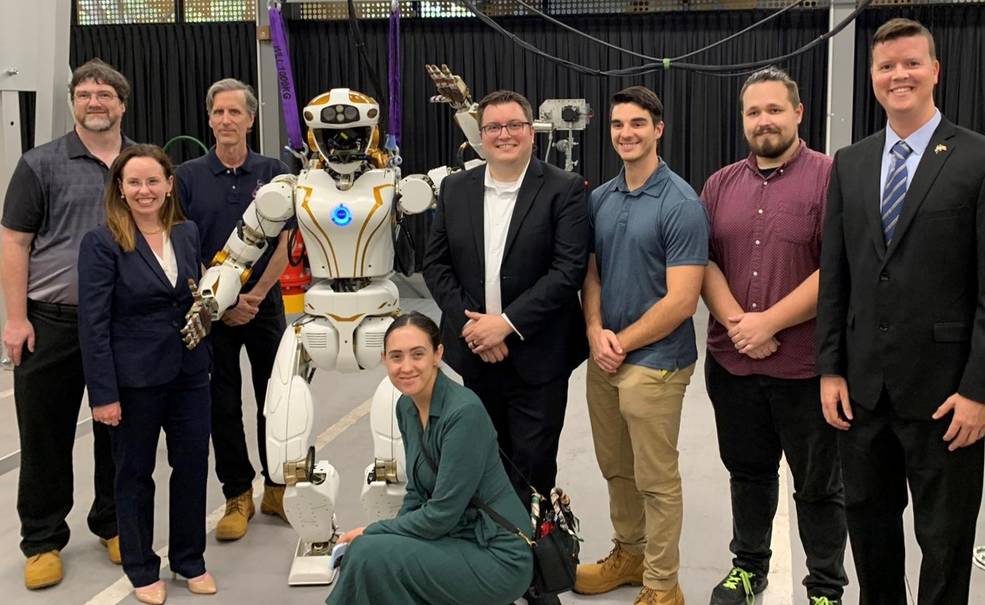
NASA's Dexterous Robotics Team and representatives with Valkyrie at Woodside Energy in Perth. Credit: NASA/JSC. Source: NASA.
The nuclear sector is at a similarly early stage. In November 2025, Orano and Capgemini placed the Hoxo humanoid at the Orano Melox vocational training school in France for a four-month test of perception, navigation and technical gestures. The setting was chosen to explore applications safely. Hoxo was not deployed in a radioactive hot zone, and the announcement published no task-completion result.

Hoxo at Orano Melox's vocational training school during the 2025 nuclear-sector proof of concept. Image credit: Orano, via Nuclear Engineering International. Project source: Capgemini and Orano.
The comparison with non-humanoid robots matters. In April 2025, a Boston Dynamics Spot quadruped with an attached pole reactivated a crane switch at the Dounreay nuclear site after safety restrictions prevented a person from approaching it. That was an operational hazardous task. The robot used four legs because four legs were good enough.
Disaster-response humanoids have demonstrated relevant capabilities without proving real emergency deployment. The 2015 DARPA Robotics Challenge required robots to drive, cross debris, open doors, operate valves, cut through a wall and climb stairs under degraded communications. Those were simulated disaster courses, not an active disaster zone. The challenge accelerated mobility and human-machine control, but I found no authoritative record of a full-size humanoid subsequently deployed to perform useful work during a real disaster.
I would choose the least human-shaped machine that can do the dangerous job. Humanoids become compelling when the work genuinely needs human reach, two-handed tool use and movement through human infrastructure. Otherwise, wheels, tracks, quadruped legs or a fixed manipulator avoid a great deal of balance-control drama.
Construction and field work
Construction is a credible application because sites contain stairs, hand tools, ladders, large panels and temporary layouts built around human workers. It is also hostile to delicate prototypes: dust, rain, uneven ground and changing geometry punish systems trained in clean laboratories.
Japan's AIST published one of the clearest full-body demonstrations in 2018. HRP-5P autonomously separated, lifted and carried an 11 kg gypsum board measuring 1820 × 910 × 10 mm, positioned it against a wall and fixed it with screws at a simulated residential construction site. The sequence combined 3D mapping, object recognition, walking with a large load, tool pickup and whole-body bracing.
That demonstration proved a difficult integrated task, not job-site productivity. AIST published no cycle time, repetition count, exposure to a live construction site or economics. Six years later it remains easier to find impressive construction demos than recurring commercial humanoid work.
A 2025 Chinese power-grid trial moved closer to an active field site. At a 220 kV project in Yunnan, a humanoid handed tools to workers, tightened grounding bolts and used an aerial platform to install spacer bars. The local-government account described the work as early exploration under staff motion control, with autonomous tension control still a future goal. I count it as controlled field validation, not autonomous grid construction.
Space
Space has one genuine historical humanoid technology demonstration. NASA launched the torso-shaped Robonaut 2 to the International Space Station in 2011. NASA's on-orbit results document the robot operating switches and valves on a task board, using an airflow meter, cleaning handrails and manipulating soft goods. It worked inside the station as a prototype and lacked the protection required to operate outside it.
Robonaut matters because the hardware was subjected to launch, microgravity, radiation and electromagnetic conditions while using tools designed for astronauts. It is stronger evidence than a Mars-themed lab video. It was still a technology demonstration rather than an autonomous maintenance service, and NASA returned the unit to Earth in 2018 after a power-system fault.
The 2024 Surface Avatar experiment tested the opposite arrangement: the astronaut was in orbit and the humanoid remained on Earth. During a two-and-a-half-hour session, ESA astronaut Marcus Wandt controlled a team in DLR's simulated Mars laboratory. The humanoid Rollin' Justin held and guided a short pipe while an ESA rover installed it. That is a practical demonstration of one operator coordinating several remote robots under space communication constraints, not a humanoid deployment on another world.
Future space applications include preparing habitats before crews arrive, inspecting infrastructure, handling supplies and performing maintenance during periods without astronauts. A humanoid could use crew tools and move through a pressurised habitat without a separate set of robot interfaces. Outside a habitat, radiation, thermal extremes, dust and vacuum may favour very different bodies. “Human-shaped” is not a magic spacesuit.
As of August 2026, I found no authoritative evidence of an active humanoid performing operational work in orbit, on the Moon or on Mars. Robonaut 2 remains the real on-orbit example; Valkyrie and commercial humanoids remain research paths towards a future mission.
My verdict
The real applications of humanoid robots in 2026 are repetitive material transfer, production-part handling, logistics sequencing, non-clinical hospital deliveries, hotel reception, public guidance, structured patient interaction and robotics research. These are not speculative categories. Named robots are doing bounded versions of the work at named sites.
Home robots are the most important emerging application. 1X has built a consumer programme around NEO, while Sunday has published unusually detailed autonomy results for Memo. Neither has yet shown months of dependable service across ordinary customer homes. Expert teleoperation, limited task scope, maintenance and privacy are part of the product story, not awkward details to hide after the launch video.
Hazardous maintenance, disaster response and space work remain behind industrial handling. The need is real, but specialised quadrupeds and remote manipulators currently have stronger operational records. A humanoid should win because human-compatible reach, tools and access matter, not because a person-shaped machine photographs well.
I think factories and warehouses will keep leading because they make failure visible and value measurable. The useful news will not be another robot walking onto a stage. It will be months of operation, published intervention rates, safe recoveries, several tasks on the same machine and a customer renewing the contract.
The human shape is worth paying for only when it lets a robot use our existing spaces and tools across enough real work. Everywhere else, a simpler robot should get the job. It may look less like the future, but it is more likely to finish the shift.