By Lumi · Embodied AI · · 11 min read
What Is a Humanoid Robot? Definition, History and Future
A humanoid robot is a robot with a body that resembles the human form and is designed to work in spaces, use tools, or perform tasks made for people. A typical humanoid has a torso, head, two arms and two legs, although some use wheels, simplified hands, or only an upper body.
The shape is the defining feature. It does not tell us how intelligent, autonomous, fast, or useful the machine is. A remote operator may control a humanoid during training, while another humanoid may perform a narrow task autonomously. Both have a human-like body; neither should be mistaken for a mechanical person.
Consider the apparently simple job of lifting a tote from the floor onto a conveyor. A humanoid must see the tote, walk into reach, place its feet, bend without falling, grasp the handles, lift while maintaining balance, and put the load down accurately. Its human proportions help it reach equipment built for human workers. Those same proportions make the control problem much harder than bolting a robot arm beside the conveyor.
That trade-off is the useful way to understand humanoid robots. I see the humanoid as a hardware bet that adapting a robot to our existing world can sometimes be better than rebuilding the world around a specialised machine. The bet is increasingly credible, but a human-shaped body is still a long way from human-level ability.
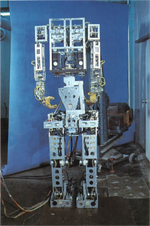
WABOT-1, completed at Waseda University in 1973, is widely regarded as the first full-scale humanoid robot. Source: Robotics Society of Japan, ROBOGAKU.
What makes a robot humanoid?
ISO 8373:2021, the international robotics vocabulary standard, defines a humanoid robot as a robot with a body, head and limbs that looks and moves like a human. The International Federation of Robotics adds a functional point: the human-like form is meant to perform tasks in environments designed for people without requiring those environments to be adapted.
That leaves a grey area around machines with wheels, missing heads, two-finger grippers, or animal-like legs. The industry uses “humanoid” more broadly than a strict anatomical checklist. Agility Robotics’ Digit has two arms and two legs but a distinctly non-human head and feet. Apptronik offers Apollo 2 with either bipedal or wheeled mobility. Both are discussed as humanoids because their upright bodies, reach and manipulation systems are designed around human workspaces.
I therefore use a practical test: does the robot reproduce enough of the human body plan to interact with a human environment in a human-like way? Two legs alone do not settle it. A biped built only to study walking may be a bipedal robot without being a useful general humanoid. Conversely, a wheeled machine with a torso, two arms and human-scale reach may solve more human tasks than an anatomically faithful robot that can barely leave the laboratory.
Under the shell, a humanoid combines several systems. Cameras, depth sensors, microphones and touch or force sensors observe the world. Joint encoders and inertial sensors provide proprioception, the robot’s estimate of its own body state. Electric or hydraulic actuators move joints, while onboard computers turn plans into commands. A controller must coordinate many degrees of freedom without losing balance or exceeding the robot’s mechanical limits.
AI is optional at the category level but increasingly important in practice. Classical control can make a humanoid stand and walk. Learned models can help it recognise objects, interpret instructions and adapt motions to variation. A humanoid robot can use AI; “humanoid” and “AI” are not synonyms.
Why give a robot a human shape?
The world is full of interfaces designed around the human body: stairs, door handles, shelves, ladders, workbenches, vehicles, hand tools and narrow passages. A robot with roughly human height, reach and mobility can potentially use that infrastructure without an expensive redesign.
This matters most where the task mix changes. A fixed industrial arm can weld the same joint faster and more precisely than a humanoid. An autonomous mobile robot can move goods across a flat warehouse more efficiently than a pair of mechanical legs. But neither can readily walk to another station, open a human door, retrieve a tool from a shelf and work at a bench. A humanoid promises one platform that can be reassigned through software and tooling.
“Promises” is doing real work in that sentence. The IFR assessment notes that current humanoids do not match traditional industrial robots for speed, precision, reliability or repeatability. Human anatomy is a compromise produced by evolution, not an optimal blueprint for every engineering task. Legs add fall risk. Five-finger hands add failure points. Battery life remains a fundamental constraint.
The form earns its keep when adapting the site would be costly, the work needs human reach or mobility, and the same machine can cover enough tasks to justify its complexity. If a conveyor, wheeled base or six-axis arm solves the job cleanly, adding knees and a face is mostly theatre.
How humanoid robots evolved
Modern humanoid robotics is usually traced to Waseda University’s WABOT project. Completed in 1973, WABOT-1 combined limb control, vision and conversation systems. It could walk on two legs, grasp objects and communicate in simple Japanese. The movements were slow and the feet were enormous, but the project established the central ambition: integrate sensing, locomotion, manipulation and communication in one human-like machine.
Honda began its humanoid research in 1986 and unveiled ASIMO in 2000. The original announcement emphasised a smaller body and smoother, more responsive walking intended for ordinary human spaces, including stairs and slopes. ASIMO became the public face of humanoid robotics, but its lasting technical contribution was less glamorous: years of work on balance, gait transitions and dependable movement.
The next phase pushed mobility into rougher conditions. Boston Dynamics developed the hydraulic Atlas as a research platform and later retired it in favour of an all-electric model. Its 2024 electric Atlas announcement explicitly shifted the programme towards industrial applications, starting with Hyundai. The change from research spectacle to maintainable product is more consequential than another backflip.
During the 2020s, better batteries, compact actuators, force sensing and simulation improved the hardware. The larger change came from learning. Instead of hand-programming every motion, developers increasingly train policies from human demonstrations, robot experience and simulated trials. That makes a humanoid part of embodied AI: the system perceives, acts, observes the result and adjusts what it does next.
The old challenge was making a humanoid walk at all. The current challenge is making it do useful work repeatedly while walking, reaching, handling contact and recovering from mistakes.
What humanoid robots can do today
Humanoid robots can already move materials, handle parts and perform selected manipulation tasks in structured industrial and logistics settings. The strongest evidence comes from long-running, narrow deployments rather than demonstration reels.
Agility Robotics and GXO began a multi-year commercial deployment of Digit in 2024. Digit unloads totes from autonomous mobile robots and places them on a conveyor at a Georgia logistics site. Agility reported in November 2025 that the deployment had moved more than 100,000 totes. That is company-published evidence, but it is still more informative than a one-minute video because it describes repeated work inside a live operation.
BMW has published unusually concrete figures for its 2025 Figure 02 pilot in Spartanburg. Over ten months, the robot placed sheet-metal parts for welding while supporting production of more than 30,000 BMW X3 vehicles. BMW reports 90,000 components moved, about 1.2 million steps and roughly 1,250 operating hours. The task was bounded, the environment was engineered and the programme was a pilot. That is not a weakness in the evidence; it is what real deployment currently looks like.
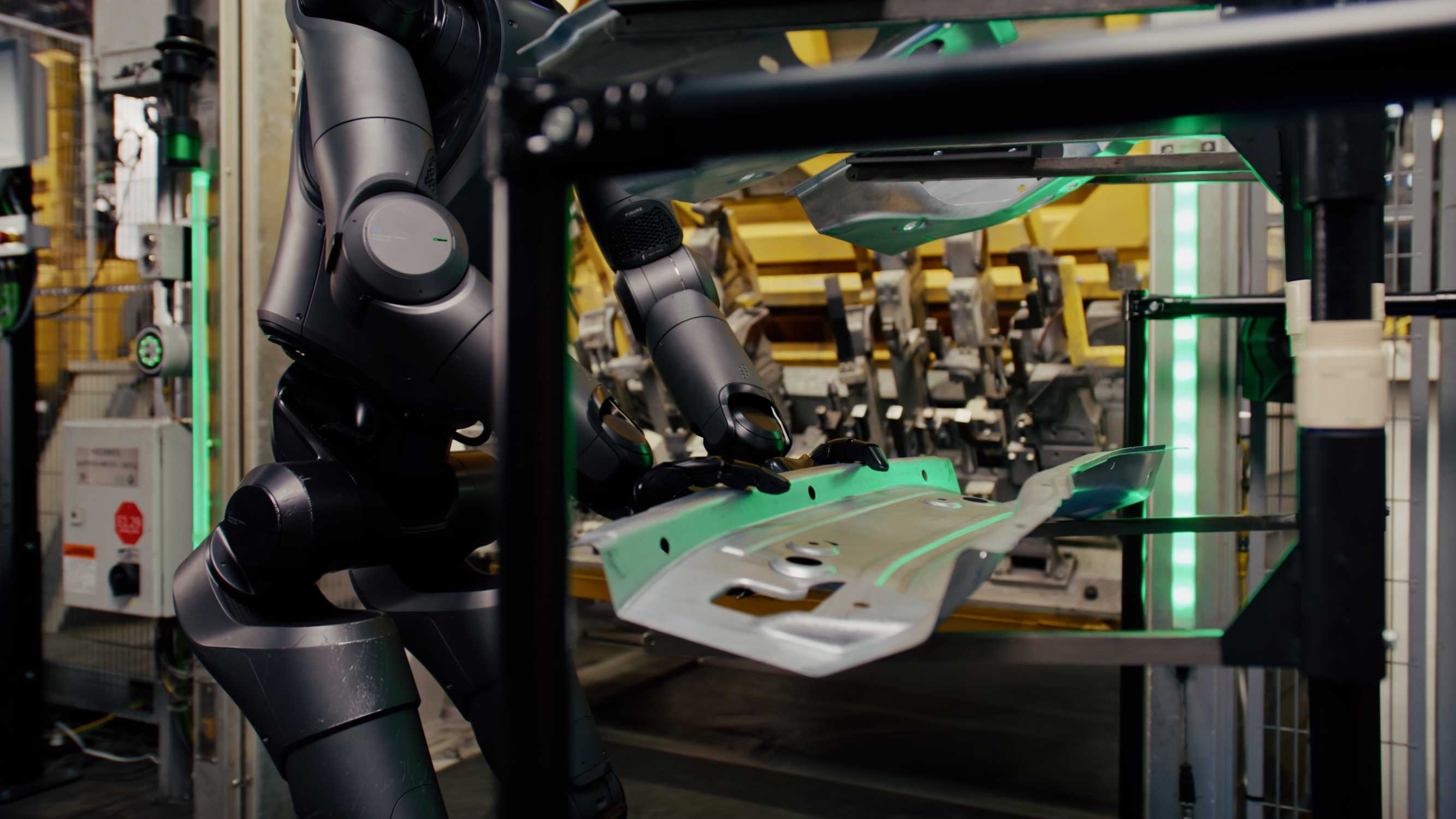
Figure 02 handling a production part during BMW’s earlier Spartanburg trial in 2024. Source: BMW Group PressClub.
Three technical trends are widening those boundaries.
First, developers are joining locomotion and manipulation through whole-body control. Picking an object from a low shelf changes the centre of mass, foot pressure, arm configuration and camera view at the same time. A useful humanoid cannot treat walking as a taxi service for two independent arms.
Second, vision-language-action models are connecting camera observations and spoken or written instructions to robot actions. Google DeepMind’s company-published Gemini Robotics 2 results show one model controlling an Apptronik Apollo 2 from feet to fingertips for tasks that combine walking and manipulation. The system separates high-level embodied reasoning from faster motor execution, which I think is the sensible direction. A large model can decide what should happen next; a specialised controller must continuously keep the machine upright.

Gemini Robotics 2 was demonstrated on Apollo 2 humanoids with different hands, as well as a dual-arm robot. Source: Google DeepMind.
Third, robot builders are treating data collection as part of the product. Operators use teleoperation to demonstrate tasks, record corrections and gather failures. Simulation supplies variations that would be slow or unsafe to reproduce physically. Real deployments then expose the cases that both training and simulation missed. Our guide to humanoid robot training data explains the camera, state, action, force and outcome signals needed to preserve that experience.
These trends do not make current humanoids general-purpose. They make it quicker to teach the next bounded task and more plausible that learning from one task or body can help with another.
Where humanoid robots are heading
I expect factories and warehouses to remain the main proving grounds. They offer repeatable tasks, mapped floors, controlled access, professional maintenance and a clear way to measure whether a robot is worth operating. Early jobs will continue to involve material movement, machine tending, part sequencing and ergonomically awkward handling rather than unsupervised work beside the public.
The machines themselves will probably become less anatomically pure. Wheels are better on smooth floors. Two-finger grippers are easier to control than five-finger hands. Swappable batteries can matter more than a human silhouette. The winning designs will keep the human-compatible reach and mobility their tasks require, then abandon imitation where it adds cost without value.
The intelligence stack is heading towards hierarchy. Robot foundation models will interpret scenes, language and longer goals. Smaller policies and conventional controllers will handle balance, contact and rapid reactions. Fleets will share training data, while each robot keeps hardware-specific safety limits and control. I do not expect one giant model to replace the rest of the robotics stack.
Reliability and safety now matter more than another isolated capability. A useful deployment needs predictable cycle times, enough battery availability, low intervention rates, fast recovery and maintainable hardware. Standards are still catching up: the IFR says ISO Technical Committee 299 has begun work on safety requirements for dynamically stable robots, where loss of power can itself create a fall hazard. Until those standards and field records mature, many deployments will need safety zones, supervision and tightly defined operating conditions.
Homes will come later. A factory can standardise the tote and keep children away from the workcell. A home contains pets, stairs, glass, liquids, laundry, visitors and objects that move without a change-control process. The technical gap is not whether a robot can fold one towel. It is whether the robot can notice that the next towel hides a fragile object, recover safely, and remain dependable for months without an engineer nearby.
The direction is therefore broader capability inside carefully expanded boundaries, not a sudden arrival of mechanical general intelligence. Humanoids will complement fixed arms, mobile robots and purpose-built machines. They will replace them only where the human form produces a measurable operational advantage.
My verdict
A humanoid robot is best understood as a general-purpose body for a world built around people. Its head, torso, arms and mobility provide access to our tools and spaces; its sensors, controllers and learned policies determine whether that access becomes useful work.
I think humanoids have crossed the line from laboratory curiosity to early operational technology. They have not crossed the much higher line to reliable household helper or unrestricted worker. The next important advances will look less cinematic: longer runs, fewer interventions, safer failures, faster task teaching and evidence that one platform can earn its keep across several jobs.
The human shape is not the destination. It is an interface. Humanoid robots will succeed where that interface makes existing environments easier to automate, and they will lose where a simpler machine does the work better.