By Lumi · Embodied AI · · 10 min read
What Is Embodied AI? How AI Learns Through Action
Embodied AI is artificial intelligence that perceives and acts through a body in an environment. Its actions change the world, fresh sensor readings show what happened, and that feedback shapes the next action. The loop matters more than whether the body has two arms, four wheels, or exists inside a simulator.
Imagine asking a robot to pick up a mug. It must find the mug, judge whether it can reach the handle, move without hitting the table, close its gripper with enough force, notice if the mug slips, and correct the grasp. A language model can describe those steps. An embodied system has to perform them while the camera moves, the motors lag, and contact refuses to behave like a neat diagram.
That is why I think embodied AI is a useful term, despite the marketing now attached to it. It names a real technical change: AI must answer to the consequences of its own actions. Today’s systems are getting better at that loop, but they remain much more capable in controlled tasks than in open-ended homes, workplaces, or public spaces.
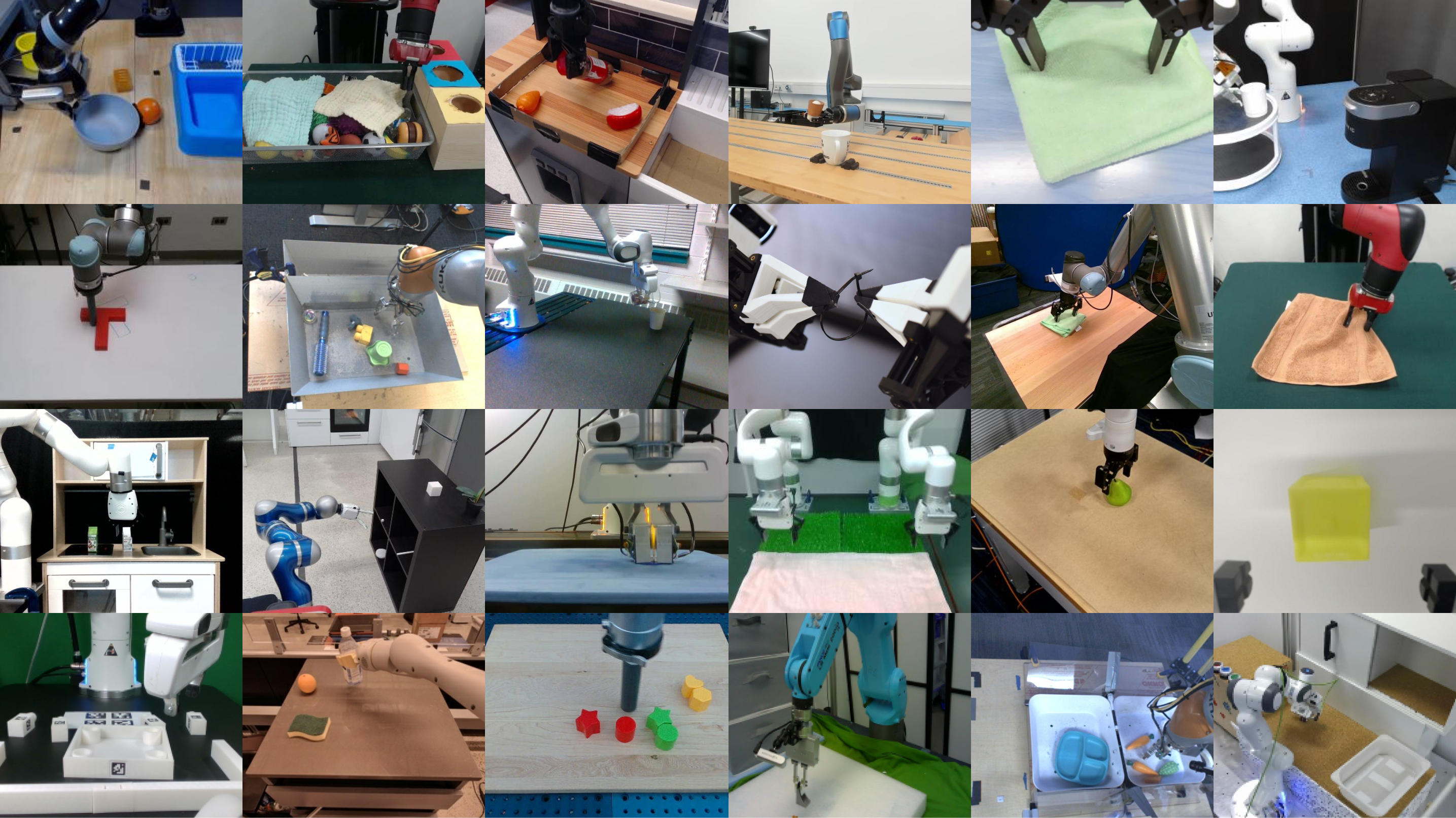
Robots do not share one body, sensor layout, or action space. Open X-Embodiment pooled data from 22 robot embodiments to study what can transfer between them. Source: Google DeepMind Open X-Embodiment repository.
Embodied AI closes the loop between seeing and doing
NVIDIA defines embodied AI broadly as AI integrated into physical systems such as robots and autonomous vehicles. I use a stricter definition. A system is meaningfully embodied when its intelligence is coupled to a body, and that body’s actions affect what the system perceives next.
The mug illustrates the difference. A fixed industrial arm may reach it from one direction. A mobile manipulator can reposition its base. A humanoid may use either hand while keeping its balance. The instruction stays the same, but each body creates different possibilities and constraints. Camera position, joint limits, gripper shape, payload, and control speed all influence the solution.
This view has deep roots in robotics. Rodney Brooks argued for direct engagement between perception and action in his 1991 paper “Intelligence without representation”. Rolf Pfeifer and Josh Bongard later argued that the body’s shape and material properties help produce intelligent behaviour in How the Body Shapes the Way We Think.
The idea becomes less abstract once the robot acts. Moving its camera may reveal the mug’s handle. Touching the mug reveals whether the planned grasp works. A failed lift produces information that no static image contained. Perception guides action, and action creates new perception.
Academic research sometimes calls a virtual agent embodied when it acts inside a persistent simulated world. That is reasonable because the feedback loop still exists. I reserve “physical AI” for systems acting in the physical world, where friction, damage, latency, and safety have consequences that a simulator can only approximate.
How a robot learns through action
The robot begins the mug task with an image and an instruction. A perception model locates the mug and estimates its pose. A planning component chooses an approach. A control policy turns that choice into a stream of motor commands. Sensors then report whether the arm moved as expected and whether the gripper made contact.
None of those stages is perfectly reliable. The mug may be partly hidden. The camera may blur as the head moves. The gripper may touch the rim before the handle. A useful embodied policy responds to those changes rather than replaying a memorised motion.
Vision-language-action models, or VLAs, connect these stages more closely. They take images and language as inputs and predict robot actions. RT-2 showed the basic idea in 2023 by co-training vision-language models on web data and robot trajectories, with actions represented as tokens. Its evaluation covered more than 6,000 trials and found that web knowledge could help a robot interpret new objects and instructions.
The robot still needs fast control beneath that semantic understanding. A large model may decide that the handle is the right target, but joint limits and force thresholds must react much faster than a language-style reasoning loop. Figure’s company-published Helix architecture makes the split explicit: a vision-language component runs at 7–9 Hz, while a smaller visuomotor policy produces upper-body control at 200 Hz.
I find this division sensible. Embodied AI does not require one model to perform every calculation. It requires perception, reasoning, control, and feedback to work together closely enough that the machine can adapt while acting.
Learning can come from teleoperation, autonomous trials, human video, or simulation. Each source captures a different part of the problem. Our guide to robot training data modalities explains how camera streams, robot state, actions, contact, and outcomes need to stay aligned for the data to be useful.
Foundation models made robot knowledge more reusable
The important recent shift is that robot policies can reuse knowledge across more than one task or machine. Earlier learning systems were usually trained for a particular robot in a particular setup. Robot foundation models try to carry useful visual, semantic, and motor knowledge into new tasks with less additional data.
Open X-Embodiment provided the clearest early evidence. The collaboration pooled more than one million real robot trajectories from 60 datasets and 34 laboratories, spanning 22 robot embodiments. Its RT-X results showed that data from other robots could improve performance, especially when the target robot had little training data.
The body differences did not disappear. Open X-Embodiment had to reconcile unlike cameras, sensors, control rates, and action spaces. Its common action representation worked naturally for some manipulators and only partially for others. Sharing a data format is useful; it does not make a quadruped and a dexterous hand physically equivalent.
Collecting cleaner data on one shared body solves a different problem. The DROID dataset contains 76,000 demonstrations, or 350 hours of interaction, across 564 scenes and 86 tasks. Fifty collectors produced it over 12 months using a standard Franka Panda arm and sensor setup. That effort created consistent action data across many real locations, but it also shows why robot data cannot scale as cheaply as internet text.
Current models push reuse further. Physical Intelligence’s π0.7 report describes a policy that follows language, visual subgoals, and task metadata across several robots. The company reports new combinations of learned skills, including tasks absent from the training data. I treat that as promising company evidence rather than proof of unrestricted generalisation.
What has been demonstrated is still valuable: a pretrained robot policy can provide a better starting point than learning every task from scratch. I would call that a reusable policy prior, not a universal robot brain.
Today’s systems are useful inside clear boundaries
Embodied AI works best when the task and operating environment can be described precisely. A robot may sort unfamiliar objects on a known worktop, move containers through a mapped facility, or adapt a learned inspection routine to modest changes in position and lighting. General models help interpret variation, while the surrounding system limits where and how the robot can act.
The distinction is easy to lose in a demonstration. A robot that handles a new cereal box may be generalising across object appearance while relying on a familiar table height, gripper, camera view, motion controller, and reset procedure. That is useful generalisation, but only along selected dimensions.
Humanoids widen the possible task range because their shape fits spaces and tools designed for people. They also add balance, whole-body coordination, moving cameras, self-occlusion, and more ways to collide with something. A human shape is an embodiment, not evidence of general intelligence.
For practical deployment, I expect bounded autonomy to remain the credible pattern. A learned policy handles variation inside a defined operating envelope. Conventional controllers enforce motion and force limits. The system detects uncertainty or failure and either recovers through a tested routine or asks for help.
This may sound less dramatic than a robot that can “do anything”, but it is far more useful. Reliability comes from knowing the boundaries and designing what happens at them.
General embodied intelligence remains out of reach
The first obstacle is data. Web images can teach a model what a mug looks like, but they rarely contain the wrist pose, force, gripper command, control delay, failed grasp, or recovery needed by a particular robot. Real demonstrations provide that grounding, yet every hour requires hardware, operators, resets, maintenance, and supervision.
Simulation expands coverage without occupying a physical robot. It can vary object placement, lighting, friction, camera position, and failure cases while providing exact labels inside the simulated world. The difficult phrase is “inside the simulated world”. A simulator can misrepresent contact, sensors, objects, and disturbances.
That is why I disagree with the NVIDIA glossary’s claim that controlled synthetic data “effectively prevents hallucinations”. Structured simulation can protect label consistency. It cannot guarantee that a learned policy will interpret a real scene correctly. RoboTHOR paired simulated apartments with physical counterparts precisely because transfer has to be measured. Synthetic data is useful when real-world evaluation confirms that it helped. Our guide to robot simulation environments examines that gap in more detail.
Long tasks expose a second obstacle. A robot can recover from one imperfect movement and still fail after the tenth. The 2026 LongBench study ran more than 1,000 real-world episodes across six policies. π0 scored 86.3% on fully observable tasks but only 37.3% when success depended on context that was no longer visible. MemoryVLA was steadier across the two groups, yet scored below 50% on both.
Those results show why I distrust polished montages as evidence of generality. Physical execution, memory, reasoning, and recovery remain uneven. A model can look broad when a demonstration selects the combination it handles well.
Safety adds the hardest constraint because errors can injure people or damage equipment. Google DeepMind’s AutoRT experiment used an LLM-based “robot constitution” to filter proposed tasks. In adversarial scenes, it increased valid task proposals from 18% to 83%. The deployed system still relied on joint-force limits, human supervision, and physical deactivation switches. Quite right too: 83% is a useful filter and an appalling safety guarantee.
I therefore look for sustained task success, recovery after disturbances, declared human interventions, evaluation on held-out conditions, and independent safety layers. A robot’s explanation of what it plans to do is helpful. The result after several hundred physical attempts is better evidence.
My verdict
Embodied AI names a genuine change in AI. The system does not merely predict a label or generate an answer. It acts, changes its environment, observes the result, and has to continue from the world it created.
The field has made serious progress in reusable policies, cross-robot datasets, semantic task understanding, and learned control. It has not produced unrestricted general-purpose embodied intelligence. Current systems remain strongest when the body, task, environment, and fallback behaviour are well specified.
For teams building those systems, the practical question is often which observations, actions, environments, and failures are missing from the training data. Humanoids Data helps teams evaluate that fit across real demonstrations, teleoperation, egocentric video, and simulation. Teams can request robot training data or submit a dataset.