By Lumi · Humanoid robot data · · 11 min read
Unitree G1 vs AgiBot X2: Specs, Price, Development Access, and 3D Models
The base Unitree G1 is the lower-priced machine on current official listings: $13,500 versus $24,240 for the AgiBot X2. Both are roughly 1.3 m tall and 35 kg, but their configurations differ. Unitree lists a depth camera and 3D LiDAR on the G1. The base X2 has more articulated degrees of freedom—25 versus 23—and more human-facing interaction hardware, but no LiDAR, RGB-D camera, or official secondary-development support.
That last point changes the buying decision. Unitree says the base G1 does not support secondary development and directs developers to G1 EDU. AgiBot says the same about the base X2 and reserves its AimDK development stack, richer perception, and optional hands for X2 Ultra. The useful research comparison is therefore G1 EDU versus X2 Ultra, and both are quote-only.
All figures below are manufacturer-published specifications checked on 23 August 2026, not independent test results. Where current pages and released robot models disagree, I keep the discrepancy visible instead of choosing the more flattering number.


Unitree G1 and AgiBot X2 product images. Sources: Unitree official store and AgiBot official store.
Specification comparison
The table separates each base product from its development-oriented version. That avoids treating optional hands, compute modules, or sensors as standard equipment.
| Specification | Unitree G1 | Unitree G1 EDU | AgiBot X2 | AgiBot X2 Ultra |
|---|---|---|---|---|
| Public price | $13,500, before tax and shipping | Contact sales | $24,240, before shipping and import costs | Contact sales |
| Standing dimensions | 1320 × 450 × 200 mm | 1320 × 450 × 200 mm | 1310 × 460 × 210 mm | 1310 × 460 × 210 mm |
| Weight | About 35 kg with battery | About 35 kg+, configuration-dependent | About 35 kg | About 39 kg on the product page; about 45 kg for the newer v1.4 model revision |
| Published DoF | 23 | 23–43, depending on waist, wrist, and hand options | 25 | 30 in the current product table |
| Leg / waist / arm DoF | 6 per leg / 1 / 5 per arm | 6 per leg / 1 + 2 optional / 5 per arm + 2 optional wrist axes | 6 per leg / 3 / 5 per arm | 6 per leg / 3 / 7 per arm, plus 1 neck axis |
| Published torque field | 90 N·m maximum knee-joint torque | 120 N·m maximum knee-joint torque | 120 N·m peak joint torque | 120 N·m peak joint torque |
| Arm load | About 2 kg; strongly posture-dependent | About 3 kg; strongly posture-dependent | 3 kg in specific postures; ≤1 kg across the full range, excluding end effector | Same published limits as X2 |
| Published speed | Not stated in the current table; 2024 official material said about or over 2 m/s | Same dated claim; no current maximum in the table | Up to 1.8 m/s; typical ≤0.8 m/s; laboratory ≤2 m/s | Same published limits as X2 |
| Battery and stated runtime | 9000 mAh, 13-series lithium; about 2 hours | 9000 mAh, 13-series lithium; about 2 hours | About 500 Wh; about 2 hours walking at 0.5 m/s; ≤1.5-hour charge | Same product-page figures; AimDK separately reports about 421 Wh |
| Perception | Depth camera, 3D LiDAR, microphone array | Depth camera, 3D LiDAR, microphone array | Interactive RGB camera, head-touch sensor, microphone array | 3D LiDAR, RGB-D, front stereo RGB, interaction RGB, rear RGB, head touch |
| Compute | Unspecified 8-core CPU | 8-core CPU; optional high-compute module such as Orin | Two RK3588 boards | Product page: RK3588 ×2; AimDK: RK3588S + RK3588; plus Orin NX, stated as 157 TOPS |
| Hands / end effectors | No actuated hand DoF listed | Optional 7-DoF Dex3-1 hands; tactile arrays optional | No compatible optional hand listed on the current product page | Optional OmniHand or OmniPicker, sold separately |
| Secondary development | Not supported | Supported | Not supported | Supported through AimDK and ROS 2 tooling |
The source rows come from the current Unitree G1 specification, Unitree store listing, AgiBot X2 specification, AgiBot store listing, and X2 AimDK documentation. Battery capacity is left in each vendor's published unit because converting the G1's ampere-hours to watt-hours requires an explicit nominal voltage that its current table does not provide.
The base-model comparison is mostly about price and access
At public list price, the X2 costs $10,740 more than the G1, or about 80% more. Shipping is also separate: Unitree quotes $300–$1,200, while AgiBot quotes $500–$3,000. Import duties and taxes remain the buyer's responsibility. Unitree currently marks the G1 as backordered; AgiBot's X2 listing accepts an order but asks buyers to contact customer service for delivery details.
The cheaper G1 is not automatically the better development platform because the $13,500 version is deliberately restricted. Its store listing says, “This product does not support secondary development,” and points customisation buyers to G1 EDU. AgiBot's table likewise marks X2 secondary development as unsupported and X2 Ultra as supported.
For a lab, this creates a simple procurement rule: compare quotes for G1 EDU and X2 Ultra before comparing SDKs. The dedicated X2 Ultra listing is enquiry-only. The base prices are useful for an entertainment, demonstration, or preset-motion purchase. They are not the prices of equivalent secondary-development-supported configurations.
Mobility and payload numbers need qualification
The bodies are almost the same size. G1 is 10 mm taller and 10 mm narrower on the published dimensions, while both base robots are about 35 kg. That similarity does not establish equal balance, impact tolerance, gait quality, or fall recovery. None of those outcomes can be read from a dimension table.
Speed is not a clean win either. AgiBot currently states up to 1.8 m/s, typical operation at or below 0.8 m/s, and a laboratory ceiling of 2 m/s. Unitree's current parameter table omits speed. Its 2024 launch material said about 2 m/s, while a later official event article said over 2 m/s. Those are dated vendor claims, not a current matched test.
Torque labels are also different. Unitree's 90 N·m and 120 N·m figures refer to the maximum knee-joint torque and explicitly say that joint motors across the robot differ. AgiBot publishes “peak joint torque” of 120 N·m without making that a whole-body continuous rating. A fair actuator comparison would need per-joint continuous torque, peak duration, speed-torque curves, thermal limits, gearing, and control bandwidth.
Payload has the same posture problem. Unitree says G1 arm load varies greatly with extension and gives about 2 kg for G1 or 3 kg for EDU. AgiBot is more specific: 3 kg only in certain postures and no more than 1 kg across the full arm workspace, excluding the end effector. These numbers should not be turned into a claim that one robot can reliably carry a named object through an arbitrary whole-body task.
Sensors and compute point to different jobs
The base G1 is better instrumented for spatial perception on paper. Unitree lists a depth camera and 3D LiDAR on both versions, plus a four-microphone array, speaker, Wi-Fi 6, and Bluetooth 5.2. The current page does not identify the depth-camera model. Unitree's LiDAR documentation says G1 units produced after April 2026 changed from Mid-360 to “Mid360s,” so revision tracking matters.
The base X2 is more visibly designed for interaction. It has an interactive RGB camera, head-touch sensing, microphone array, wireless microphone, speaker, screen, and lighting effects. It does not include the Ultra's LiDAR or RGB-D camera. AgiBot reserves autonomous navigation, obstacle avoidance, and optional auto-charging for customised Ultra configurations; the charging dock is separate.
Compute follows the same split. Unitree identifies only an 8-core CPU in both versions and offers an optional high-compute module such as Orin on EDU. AgiBot names two RK3588 boards in X2 and adds an Orin NX rated at 157 TOPS to Ultra. TOPS is an accelerator throughput claim, not a measure of end-to-end policy latency, so deployment decisions still need a test on the intended model, camera rate, and control loop.
Hands change the manipulation comparison
Neither public base price buys a dexterous manipulation configuration.
The G1 table lists no actuated hand DoF on the base model. G1 EDU can add two 7-DoF Dex3-1 hands, optional tactile arrays, and two wrist axes per side. Unitree's separate Dex3-1 page describes three active fingers per hand and a tactile-equipped configuration with 33 tactile sensors on one hand.
AgiBot says its OmniHand and OmniPicker end effectors are compatible only with X2 Ultra, are not standard equipment, and must be purchased separately. The base X2 therefore should not be compared with a hand-equipped G1 EDU in a manipulation benchmark without showing the added hardware and price on both sides.
For training data, hand choice changes more than grasp appearance. It changes the action vector, joint limits, tactile channels, tool transform, failure modes, and which demonstrations can transfer. The guide to open-source humanoid robot hands explains why a hand's simulator, calibration, and licence belong in the dataset record.
Official interactive 3D models
Both companies publish simulation descriptions, but not for exactly the same products. Unitree's official repository includes current G1 URDF, MJCF, and STL files for several 23- and 29-DoF revisions. AgiBot's model repository publishes URDF, MuJoCo XML, and STL files for X2 Ultra v1.3 and v1.4; it does not list a base-X2 model.
The viewers below load the original visual geometry from pinned official repository revisions only after you press the button. The X2 model is a large download. It represents the newer X2 Ultra -N nameplate revision, not the transformable X2-N research prototype and not the $24,240 base X2.
Unitree G1
23-DoF mode 10
Official current 23-DoF URDF and STL visual geometry. Download size: about 24 MB.
AgiBot X2 Ultra
X2 Ultra -N · URDF package v1.4.0
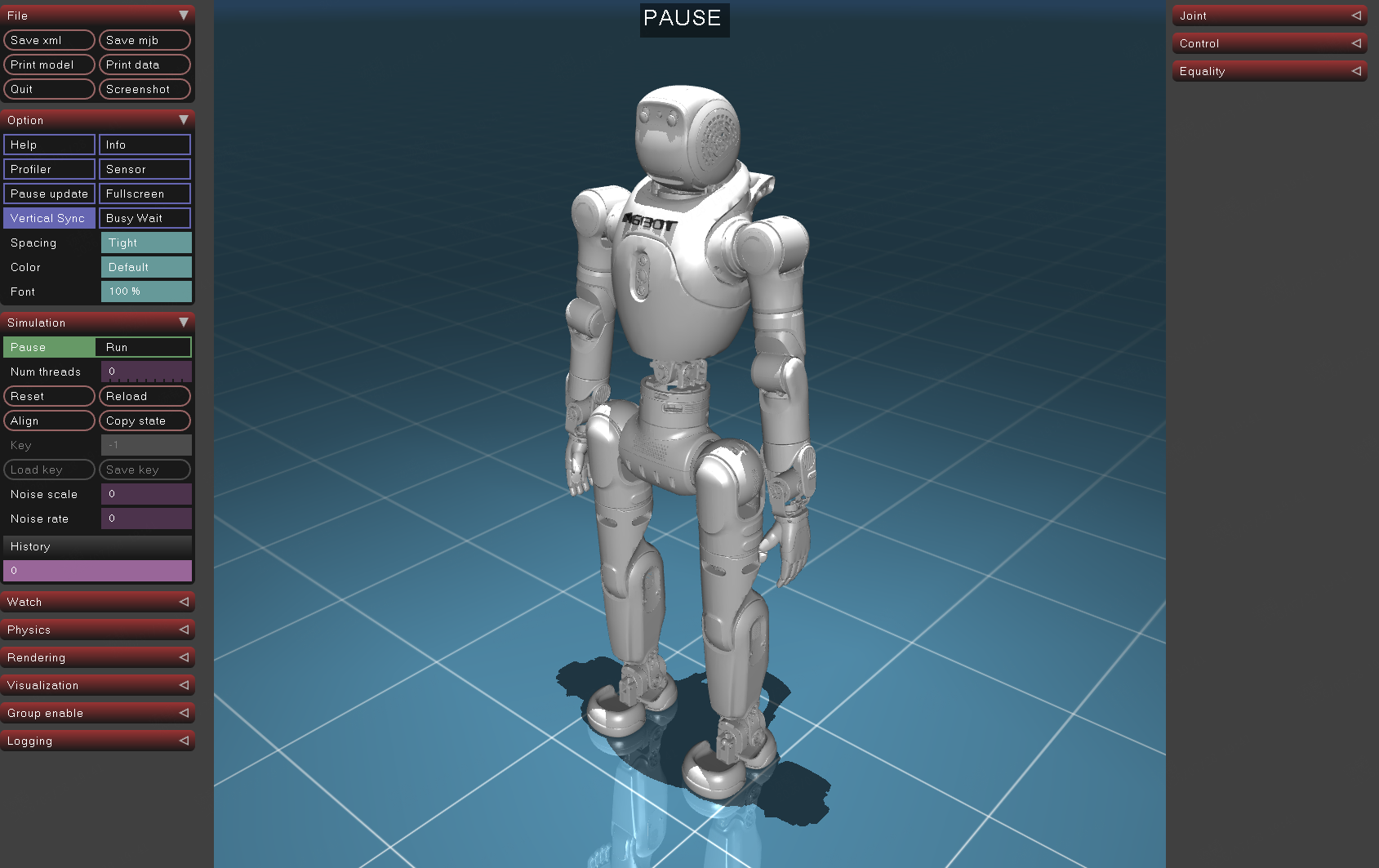
AgiBot has not released a base-X2 model. This official X2 Ultra -N package downloads about 79 MB of visual geometry.
These are robot-description assets for simulation and visualisation, not manufacturing CAD and not synchronised digital twins. Unitree releases its package under BSD 3-Clause. AgiBot uses Mulan PSL v2. Both licences permit redistribution and modification subject to their notice and other conditions, but product photography and trademarks are separate.
The files also expose a useful specification warning. AgiBot's current commercial table says 30 DoF and one neck axis. The released X2 Ultra URDF retains a 31-joint, two-neck-axis kinematic description, while the current AimDK joint table fixes head pitch at zero. The v1.4 model README also says the newer hardware revision increased mass from about 41 kg to about 45 kg, versus about 39 kg on the live product page. A URDF filename is not a substitute for the delivered unit's nameplate, bill of materials, and joint map.
Development access matters more than the headline DoF
A degree of freedom count says how many independent coordinates describe configuration under the vendor's convention. It does not say which axes are actuated, exposed to the SDK, safe to command simultaneously, or represented in a training dataset.
G1 EDU has the broader published configuration range, from 23 to 43 DoF, because optional waist, wrist, and hand axes are counted. X2 Ultra's current table has 30 DoF, with seven axes per arm, three at the waist, and one at the neck. Those bodies will not accept the same joint-action array. Camera placement, hands, limits, controllers, and timing widen the robot embodiment gap further.
The data ecosystem makes this concrete. Unitree UnifoLM-WBT publishes whole-body G1 demonstrations with root and joint configurations. AgiBot-to-Unitree G1 Retarget takes tasks from an AgiBot source body and replaces its actuator commands with G1-compatible actions through retargeting and simulation. Preserving the original video does not make the original joint commands portable.
Before buying either platform for data collection, ask the vendor to demonstrate:
- The exact delivered hardware revision, DoF map, joint limits, and supported control modes.
- Camera, LiDAR, IMU, microphone, tactile, and hand models, with timestamps and calibration access.
- SDK and firmware versions, control frequency, safety limits, log export, and simulator parity.
- Continuous payload and torque behaviour in the intended posture, not only a peak number.
- Battery runtime while running the intended compute, sensors, hands, and task cycle.
- Warranty treatment for user-written controllers, falls, shell removal, and hardware modification.
Which robot is the stronger fit?
Choose the base G1 when public purchase price and built-in depth-plus-LiDAR perception matter more than an officially supported development interface. It is $10,740 cheaper than the base X2, but Unitree explicitly withholds secondary development from that SKU.
Choose the base X2 for preset motion and human-facing interaction when its screen, lighting, head touch, audio hardware, and 25-DoF body fit the deployment. Do not assume the base model includes Ultra navigation sensors, hands, autonomous charging, or AimDK access.
For research, policy deployment, simulation, or training-data collection, compare G1 EDU with X2 Ultra instead. G1 EDU offers the higher configurable DoF ceiling and optional tactile Dex3-1 hands. X2 Ultra publishes a named Orin NX configuration and a denser multimodal perception suite. Neither vendor publishes enough information for a universal winner, and neither public base price represents that developer configuration.
I would make the final choice with one matched acceptance task: the same payload, end effector, sensor logging, controller rate, battery duration, fall-safety procedure, and export format on both quoted configurations. That test will reveal more than adding the largest numbers in either specification sheet.