humanoidsdata.com

Search

Search companies, datasets, articles, and glossary terms for humanoids and embodied AI.

Browse a curated catalog of datasets for humanoid robots and embodied AI, spanning real-world demonstrations, teleoperation, motion capture, egocentric vision, simulation, manipulation, locomotion, and cross-embodiment robot learning.

90 Datasets · Page 2 of 8

Four camera views from five ALOHA Static bimanual manipulation tasks

ALOHA Static

ALOHA Static comprises 825 real demonstrations of fine-grained bimanual tabletop manipulation across 12 tasks, including sealing a bag, wrapping candy, opening a cup, preparing tape, using a coffee machine, fastening cable, slotting a battery, and handing over tools. The fixed ALOHA workcell records 14-dimensional joint state and action data at 50 Hz alongside four 480×640 RGB views from two stationary and two wrist-mounted cameras. The task-specific releases are distributed in LeRobot format for imitation-learning research and co-training.

View dataset →
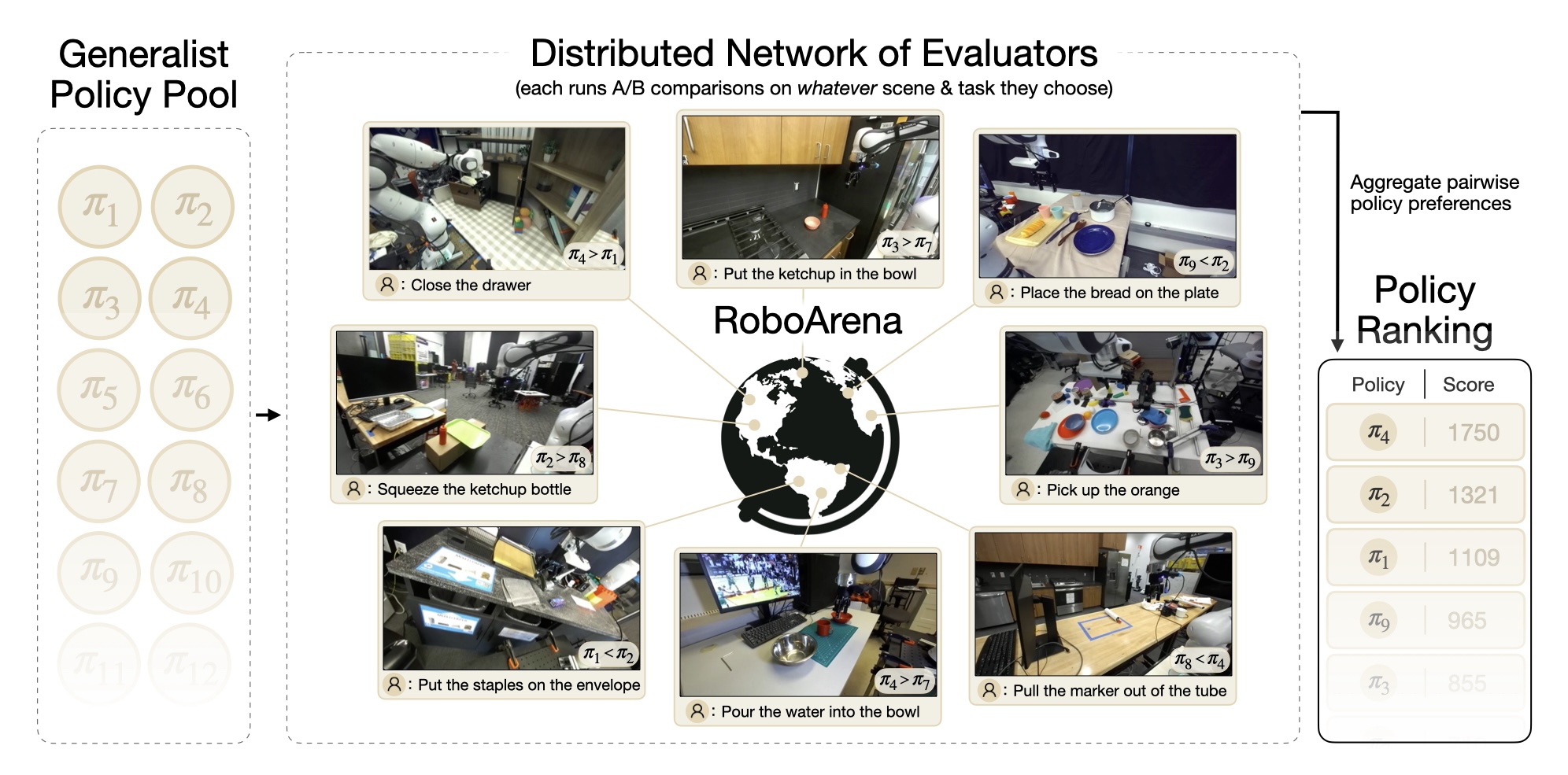
RoboArena distributed pairwise robot policy evaluation workflow

RoboArena

RoboArena is a distributed real-world evaluation dataset for generalist policies on the DROID robot platform. The July 17, 2026 snapshot contains 3,883 evaluation sessions and 10,783 autonomous policy episodes, with 27,148 multi-view videos, matching proprioception and action files, task instructions, success scores, pairwise preferences, and evaluator feedback. Double-blind comparisons let participating institutions choose their own tasks and environments while preserving matched conditions within each policy comparison.

View dataset →
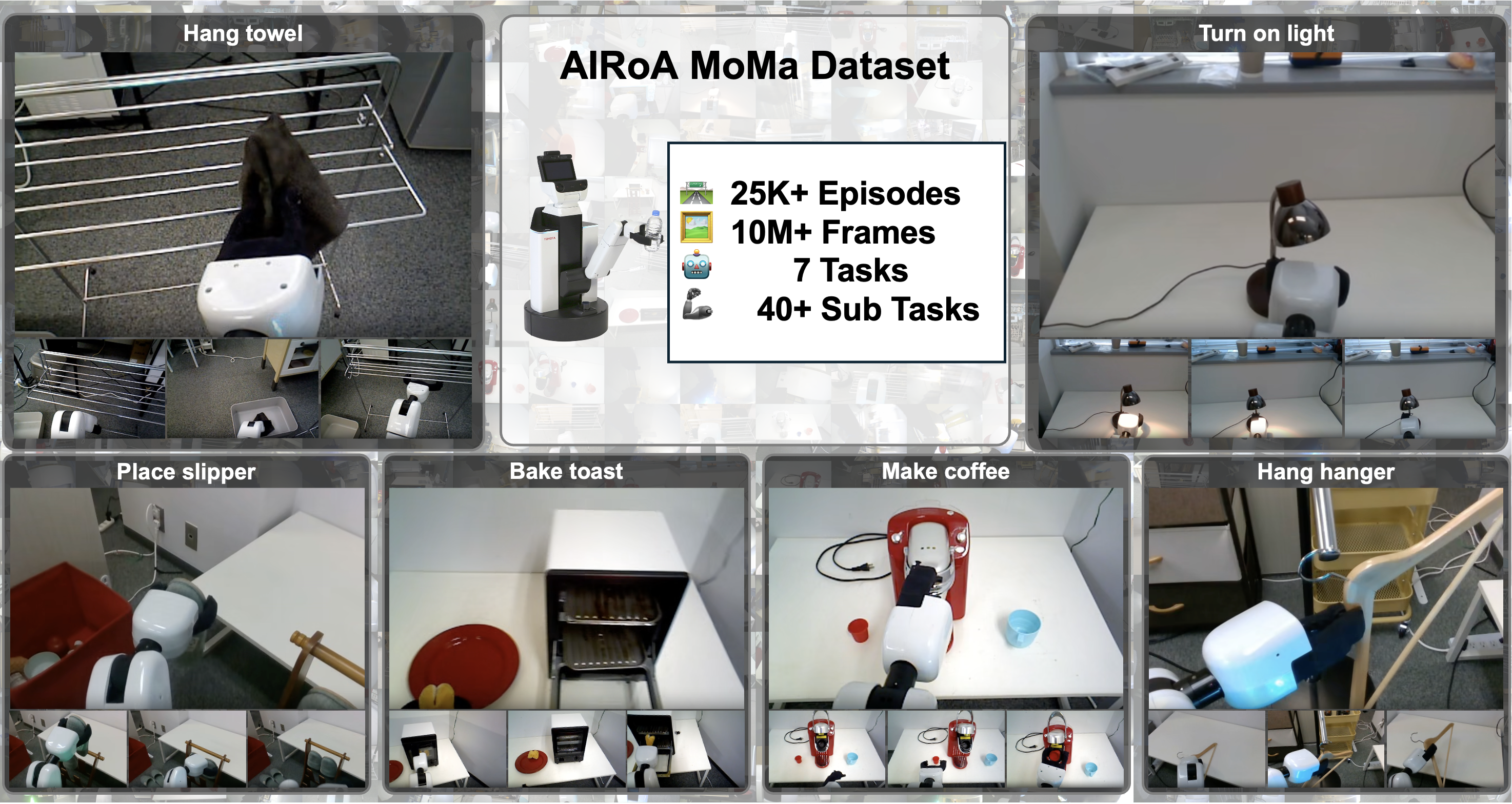
AIRoA MoMa household tasks performed by Human Support Robots

AIRoA MoMa Dataset

AIRoA MoMa v1.1 provides 23,762 filtered Human Support Robot teleoperation episodes totaling 87 hours across seven household task families. The gated LeRobot release pairs head- and hand-camera RGB video with robot state, calibration, task-success metadata, and hierarchical short-horizon and primitive-action annotations; the research dataset also records synchronized wrist force-torque signals. Nineteen operators used eight HSR robots to collect tasks including towel handling, coffee making, dishwashing, toast preparation, lamp control, and slipper organization.

View dataset →
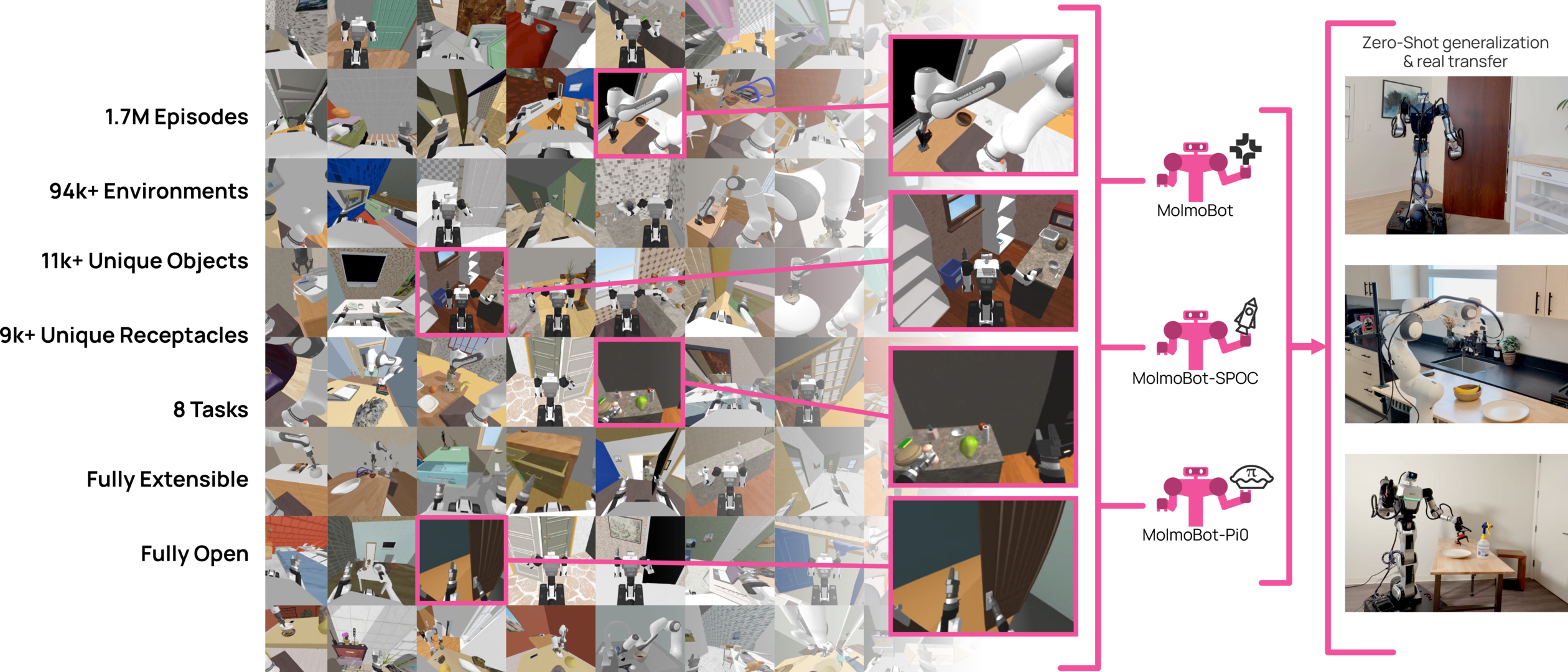
MolmoBot simulated and real robot manipulation examples

MolmoBot-Data

MolmoBot-Data contains 1.7 million procedurally generated expert trajectories totaling 5,704 hours across eight manipulation task types on Franka and RB-Y1 platforms. MolmoBot-Engine uses task-and-motion planning and randomizes objects, receptacles, lighting, and camera poses across more than 94,000 simulated indoor environments. The data supports articulated-object interaction, pick-and-place, and mobile manipulation research, including zero-shot sim-to-real policy training.

View dataset →
Top-camera view of a MolmoAct2 Bimanual YAM manipulation scene

MolmoAct2 Bimanual YAM Dataset

MolmoAct2 Bimanual YAM is a large-scale collection of real bimanual manipulation demonstrations gathered on the custom Yet Another Manipulator platform. The merged LeRobot release contains 32,246 episodes, 76 million frames, and 34 language-annotated tasks with top, left, and right RGB views plus 14-dimensional joint state and action data; the full collection is described as more than 720 hours of training data. Tasks range from folding clothes and untangling cables to scanning groceries, packing medication, and bussing tables.

View dataset →
Top-camera view from a MolmoAct2 SO-100 or SO-101 robot setup

MolmoAct2 SO-100/SO-101 Dataset

MolmoAct2 SO-100/SO-101 curates 38,059 demonstrations, 19.8 million frames, and about 184 hours from more than 1,200 public LeRobot repositories contributed by 377 users. A four-stage pipeline checks structural validity, excludes evaluation data, enforces source eligibility, and applies a TOPReward quality gate while retaining varied tasks, camera setups, objects, environments, and both low-cost arm embodiments. The release also supplies per-episode language annotations for the source datasets.

View dataset →